NMR meets MUSICIANS

Auditory presentation of free induction decay (FID) signals generated by NMR spectrometers.

Article by Walter Bauer, Institute of Organic Chemistry, University of Erlangen-Nuremberg, Germany (1996). Dedicated to Prof. Dr. Dr. h. c. Dieter Seebach on the occasion of his 60th birthday.
Preservation copy hosted by OrganicChemistryData.org — about this rescue.


1. General Overview

This article introduces the auditory presentation of free induction decay (FID) signals obtained by NMR spectrometers (NMR = Nuclear Magnetic Resonance). Usually, NMR spectrometers work in a silent mode. However, due to the fact that the results they produce are in the audio frequency range, acoustic monitoring is possible as well. It will be demonstrated below how such audio monitoring may extend the information content of pure optical presentation, thus being an aid in structure analysis. In addition, by appropriate pulse programming it is possible to play melodies on an NMR spectrometer. The underlying pulse sequences are acronymed “MUSICIANS”see below for what that mysterious abbreviation expands to.

All spectra shown below and all sounds/melodies were obtained on a JEOL Alpha500 NMR spectrometer at the NMR department of the Institute of Organic Chemistry of the University of Erlangen-Nuremberg, Germany. Spectrum recording, hardware modification and song writing was done by Walter Bauer.

2. Fundamentals of NMR

Nuclear Magnetic Resonance (NMR) spectroscopy currently is one of the most important and most widely used methods for structure analysis in chemistry. The method exploits the magnetic properties of the atomic nuclei (mostly 1H and 13C in organic chemistry). When being placed in a very strong static magnetic field, nuclei with a spin quantum number I ≠ 0 behave like tiny magnetic gyroscopes and precess about the external magnetic field axis, much as real gyroscopes “torque” about the gravitational field axis. The frequency of the nuclear spin precession usually is in the range of several hundreds of MHz, being dependent on the strength of the magnetic field and the type of the nucleus itself.

Imbedded into a molecule, atomic nuclei are not “naked” but experience a surrounding of electrons. According to the different locations in a given molecule, the electron cloud density around a particular nucleus may be different at various places. Functional groups like C=O or halides may lead to a decrease of electron density as compared to alkanes. These variations manifest in slightly different precession frequencies of the involved nuclei — the phenomenon of chemical shift. An additional feature of NMR is the mutual interaction of nuclei mediated by the bonding electrons (scalar coupling, J-coupling). A nucleus “sees” its neighbourhood nuclei, and according to the number of the coupled “partners” there will be a splitting of the corresponding line in the spectrum. Usually, these splittings may be interpreted by very simple rules and permit even more detailed insight into the structure of a molecule.

In its early years, NMR spectroscopy employed the continuous wave (CW) method: at a given fixed magnetic field an RF field generated by an oscillator was varied from high to low frequency (within very small limits, magnitude of ppm). Thus, during the measurement (ca. 1–5 min) all involved nuclei became “resonant”: they absorbed energy for the case that their precession frequency exactly matched the frequency of the applied RF field.

A more elegant and now generally employed method was introduced by R. R. Ernst (Nobel Prize 1991): a very short (order of μsec) RF pulse excites all nuclei, irrespective of their chemical shifts and their spin–spin couplings. Macroscopic magnetization is generated within a sample. At the end of the pulse, the RF receiver is turned on. The nuclei which precess with their individual frequencies induce oscillating currents in the receiver coil which are amplified and digitized for further analysis. Having been excited by the RF pulse, the nuclei turn back (“relax”) to their initial state within usually several seconds; the induced magnetization decays. Since the precession of the nuclei is free and due to the decay of the induced magnetization the whole process is termed Free Induction Decay (FID). The observation and further exploitation of FIDs plays the central role in NMR spectroscopy. Usually, several (two…thousands) of FIDs are co-added in order to improve the signal-to-noise ratio of a spectrum. The summed-up FID is then subjected to a mathematical operation (Fourier transform) which results in an NMR spectrum identical to that obtained by the CW method.

3. Auditory FID Presentation — History and Now

The idea to listen to NMR FIDs is by no means new. Early after the introduction of the pulsed Fourier transform method operators started to tap the analogue audio signals which result from mixing the RF signal of the probe with the reference signal created by the pulse oscillator. At that time (early seventies) an acoustic extension device was offered commercially by spectrometer vendors. However, the method sooner or later became forgotten, the reason presumably being the following: At the time mentioned, one-pulse experiments were dominating, some two-pulse experiments (T1, T2 measurements) were carried out non-routinely. Phase cycling as is done nowadays for 2D-NMR experiments was not carried out at that time. Hence, one FID sounded like the other, and I can well imagine that the monotonous “ping” was considered to be boring instead of contributing information.

Things have changed significantly since then. Of course, “one-pulse” experiments are still carried out routinely. I found that the monotonous “ping” of each individual FID may still contain a number of informations:

  • Approximately how many signals are present in the spectrum?
  • Are the signals close to or far from the carrier?
  • Which coupling constants are present?
  • Is the shim ok (rapid or slow FID decay)?

In cases where broad and sharp lines are present at the same time this may be easily heard: a short, rapidly decaying tone is overlayed by a different, slowly decaying tone.

In our lab, acoustic FID monitoring has proven to be highly useful for the detection of spectrum artifacts. First, we regularly switch our spectrometer from solution to solid state measurements. Solid state FIDs decay much more rapidly (for 13C, order of some 10 msec) than solution FIDs, resulting in much higher linewidths of solid state signals. We noticed that under CP/MAS conditions in some cases certain spinner rotors lead to formation of spikes in the FID (probe arcing?), resulting in degradation of signal-to-noise. These spikes may be observed optically in the FID, however, only at the beginning of a long-term measurement. In an already summed-up FID these spikes will no longer be noticeable. On the other hand, these spikes may be easily detected acoustically when listening to each individual new FID: there is a typical “cracking” or “sparkling” sound leading to a “dirty” sound of the FID noise instead of a “smooth” sound created by undisturbed FIDs.

A second case where acoustic FID monitoring has proven to be highly useful is 2D NMR. As will be familiar to the reader, phase cycling is employed in 2D NMR in order to eliminate unwanted coherences. Usually, a minimum of 4 scans per t1-increment with different pulse phases is recorded. When listening to an individual FID in the stereo mode it’s quite easy and interesting to actually hear the change of the pulse phases: this manifests either in a ping-pong like change in the stereo channels or in effects reminiscent to “flanger” sounds in music. When listening to successive pulses in a 2D experiment, after some training one intuitively co-adds the sounds in a four-beat manner. In two cases where I set up new pulse sequences this four-phase change suddenly was interrupted: two successive FIDs sounded exactly equal! An inspection of the pulse program revealed an error in writing the phase cycle. Presumably, without acoustic monitoring this error would have never been detected; artificial results would have been obtained and possibly even been published.

4. Hardware Modifications and Recording

Any descriptions of hardware modifications to existing spectrometers given in this section are provided without any warranty concerning malfunction or hardware damage!

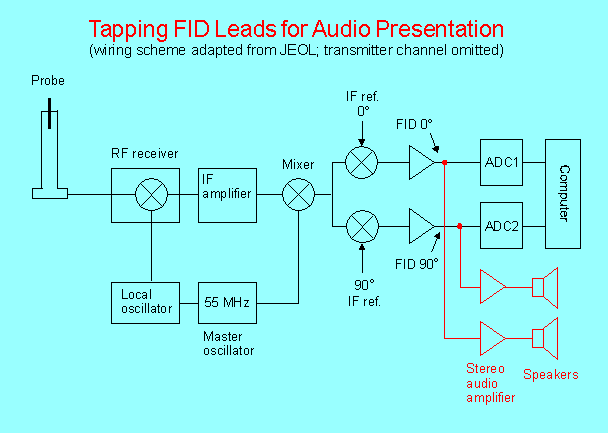
How difficult is it to modify an existing spectrometer for auditory FID monitoring? If you are familiar with electronics it takes not more than half an hour of soldering and wiring. You simply have to tap the analogue FID signal immediately before it enters the analogue-digital converter (ADC). Since spectrometers usually work in quadrature detection mode, two FID signals are present, one of them being referenced with a 90° phase shift of the intermediate frequency (IF) reference signal. These two signals may be fed into the inputs of a stereo amplifier. For our JEOL Alpha500 spectrometer, the schematic wiring diagram and the necessary modifications are indicated below.

Schematic wiring diagram of the JEOL Alpha500 audio tap

Initially, for precautional reasons I employed a stereo amplifier working with tubes. This device has a very high input impedance, thus avoiding any disturbance of the FID signal. However, I noticed that on our spectrometer the output impedance of the final-stage FID amplifier is extremely low (order of some Ohms). Hence, virtually any modern HiFi amplifier based on transistor or IC input may be employed as well.

When you try to record your FID sounds I strongly recommend to employ a digital device such as DAT tape or hard-disk recording. This is due to the following: tones obtained from an FID are among the (if not the) purest tones obtainable. They are produced by atomic nuclei and, hence, are inherently as pure as time standards obtained from cesium clocks. The only sources of imbalances that may be introduced are:

  • Jitter in the master reference frequency: not noticeable since based on quartz. Of course, at the same time this makes the NMR tones “only” as pure as tones based on a quartz clock.
  • Instabilities of the magnetic field: modern superconducting magnets are extremely stable. Long-term drifts usually are some Hertz per week. Short-time fluctuations practically do not occur in a “quiet” environment (i.e., no nearby moving steel or iron objects like subway trams, elevators etc.).
  • Instabilities of the lock system: usually not noticeable on modern instruments. In cases of doubt, measure in an unlocked mode.

When compared to the above sources of “jitter”, any analogue recording device (high-end cassette recorder and even professional studio hardware) is much more instable, resulting in an audible and more or less disgusting jitter of the tones.

5. Sound Examples

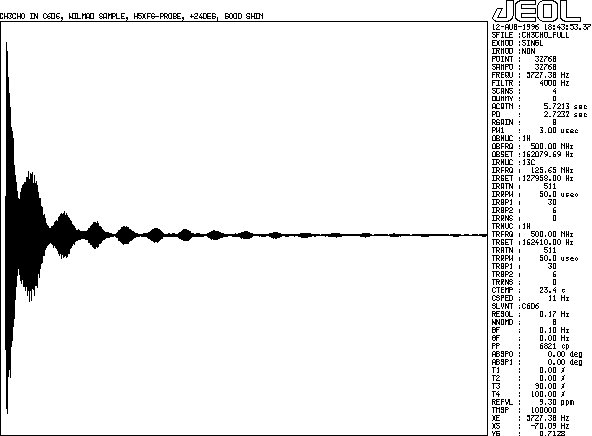
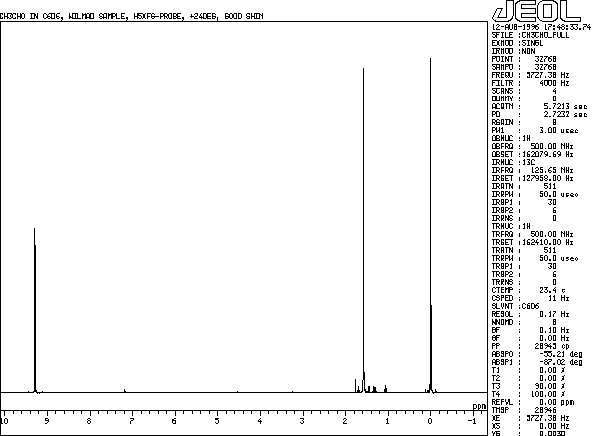
On the following you will find sounds from FIDs, along with graphical presentations of the FIDs and the Fourier-transformed spectra. The original sound files were digitized with 8 kHz sampling rate (except for the solid-state 13C CP/MAS FID below, 16 kHz) with a digital resolution of 16 bit. The sampling rate may appear to be low, note however that all tones you will be listening to are pure ground tones with inherently no overtones being present.

The audio below is FLAC, losslessly re-encoded from Bauer's original 16-bit PCM WAV files. Every modern browser plays FLAC natively.

CH3CHO, full spectrum

A 1H-spectrum of a standard sample, acetic aldehyde. The recording range is the full spectrum, the shim is good. The acquisition time is 5.7 sec. The summed-up FID and the Fourier-transformed spectrum result from 4 individual scans which may be heard sequentially in the sound file.
CH3CHO full FID
FID
CH3CHO full spectrum
spectrum

CH3CHO, quartet, good shim

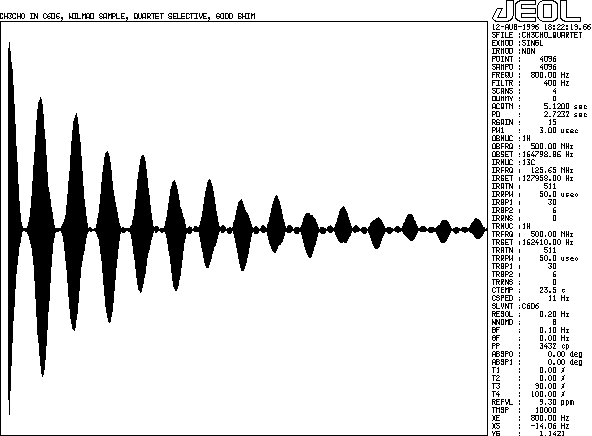
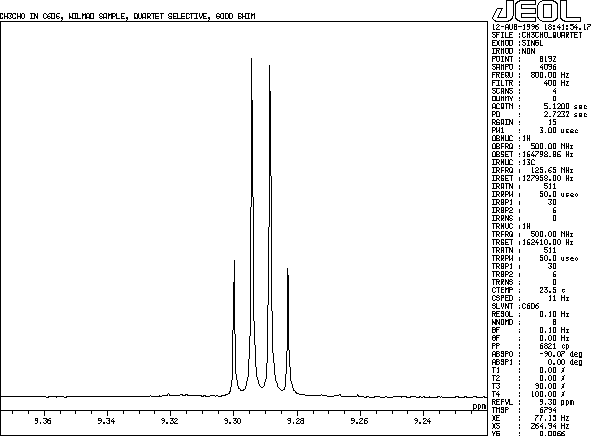
Here the transmitter is set close to the low-field quartet signal of the aldehyde proton in CH3CHO, the shim is good. The doublet of the CH3 group is far off; folding-in is prevented by the spectrometer audio filter. In each of the four scans you will hear a slowly decaying tone with typical amplitude modulations resulting from interference. This is caused by the coupling between the aldehyde proton and the CH3 group and the resulting quartet splitting (J = 2.9 Hz). The acquisition time is 5.1 sec.

CH3CHO quartet good-shim FID
FID
CH3CHO quartet good-shim spectrum
spectrum

CH3CHO, quartet, poor shim

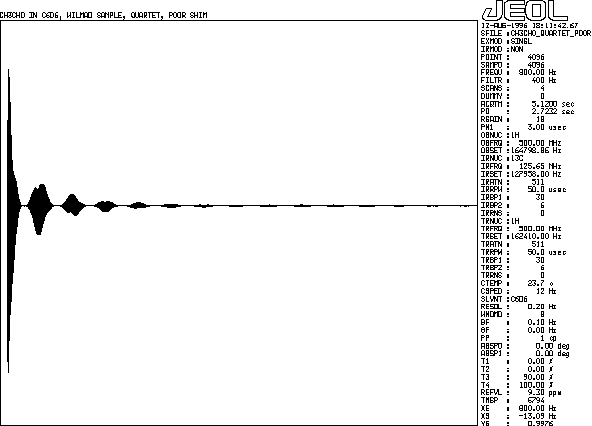
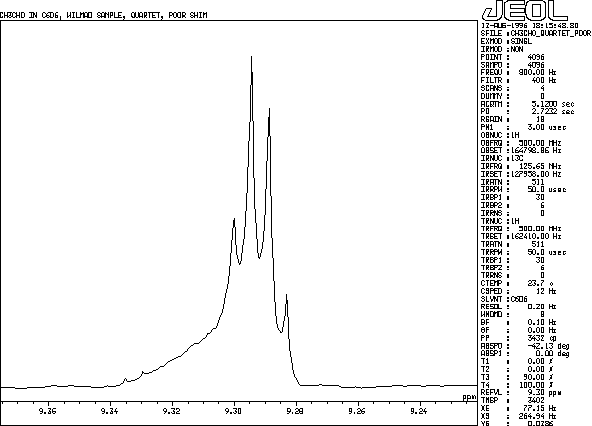
Here is the FID and the spectrum of the same quartet as above, however, with arbitrarily poor set shims Z1 and Z2. As you can see in the spectrum the result is disastrous. You can also hear the poor shim from the much more rapid decay of the FID. Despite the rapid decay, some sounds persist quite long, indicating some still sharp signals in the spectrum.

CH3CHO quartet poor-shim FID
FID
CH3CHO quartet poor-shim spectrum
spectrum

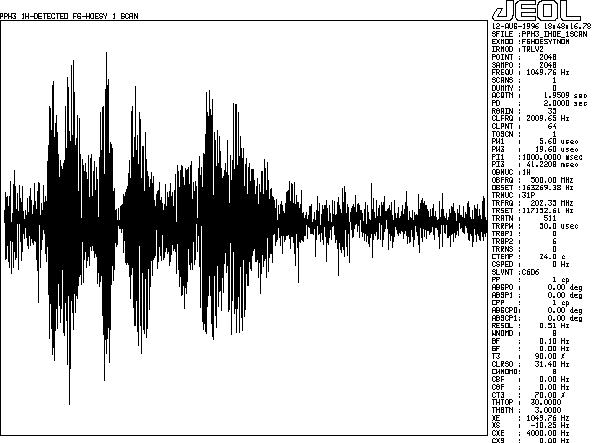
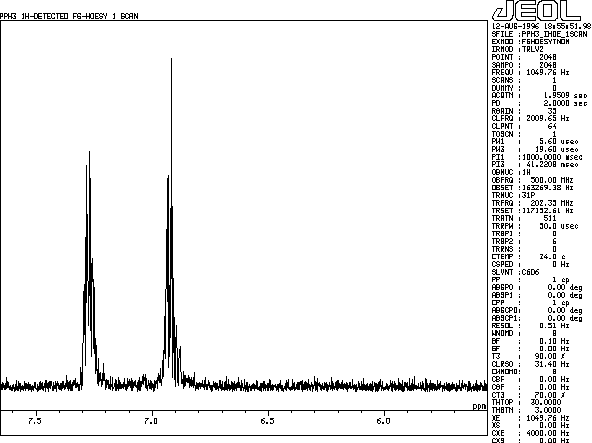
PPh3, inverse FG-HOESY (1H, 31P)

The sound and the spectrum given on this page are quite strange. HOESY is a method which exploits the nuclear Overhauser effect (NOE) between heteronuclei (here: 1H and 31P). In the present case, “inverse” detection is carried out on the 1H channel. In addition, coherence pathway selection is done by the application of pulsed field gradients (FG) instead of phase cycling. This leads to the formation of typical gradient echoes as can be easily seen and heard.

PPh3 FG-HOESY FID
FID
PPh3 FG-HOESY spectrum
spectrum

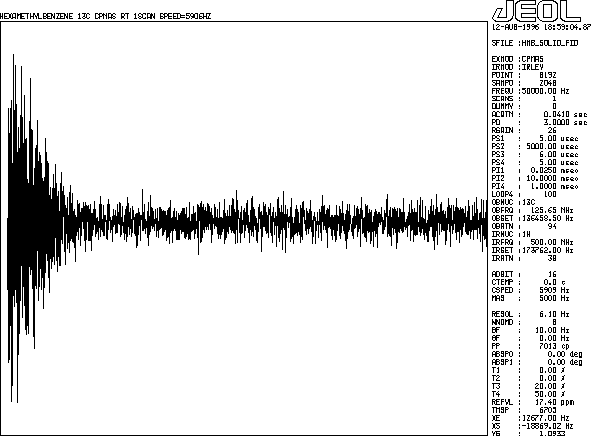
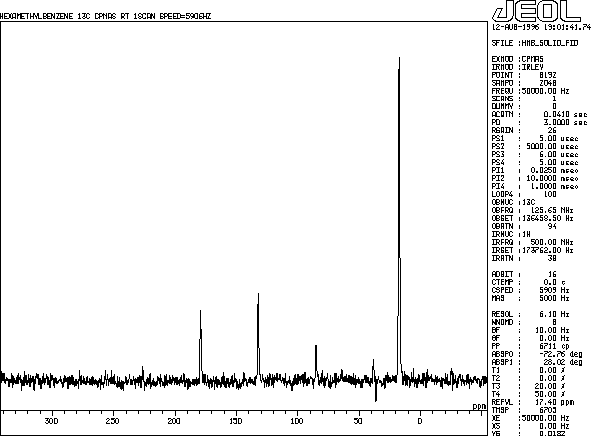
Hexamethyl benzene, 13C-CP/MAS

Solid-state NMR signals usually are considerably broader than lines obtained in solution NMR. This manifests in a much more rapid decay of the FID. In the present case of a standard sample, hexamethyl benzene (HMB), the acquisition time is only 41 msec. The FID has completely decayed after 20 msec. Note the spinning side bands of the ring carbon signal (isotropic shift δ = 132.3 ppm) due to its large chemical-shift anisotropy as compared to the CH3 group signal with nearly no side bands.

HMB solid-state FID
FID
HMB solid-state spectrum
spectrum

Sawtooth signal of 2H in acetone-d6

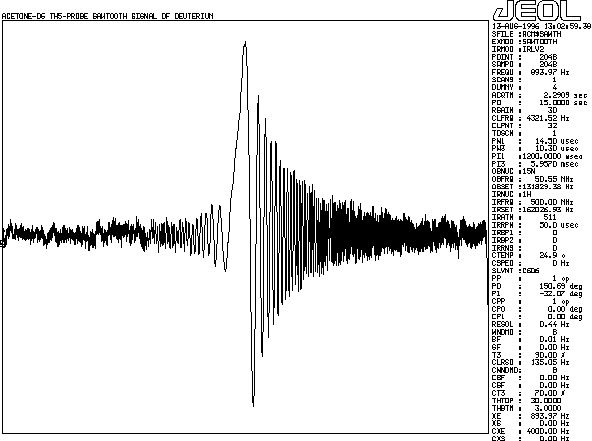
Here you may watch and listen to a CW signal instead of an FID. Any NMR spectrometer employs deuterium for solution-state measurements in order to achieve field stability. To find and monitor the lock signal the Z0 current of the shim system is stepped through in a “sawtooth” mode, i.e. a linear increase from a bottom to a top level and sudden drop to the bottom level again. Since the signal is thus rapidly scanned, typical “wiggles” of the signal appear. The peak-to-peak distance becomes ever smaller the more the Larmor condition becomes mismatched, along with an exponential decay of the signal intensity. After each re-scan, some magnetization is still left, leading to similar oscillations before (left to) the signal. Operators who work or worked with older instruments constructed in the sixties or early seventies will confirm having seen such signals thousands of times on the oscilloscope. The corresponding sound is a constant increase from low to high tone.

Sawtooth signal

Probe tuning signal

Tuning an NMR probe may be achieved in different ways: constant application of short-spaced pulses under minimization of the standing wave ratio (SWR) by using a reflection bridge, or wobbling of the NMR signal. Our spectrometer employs the first method. Here, probe tuning may be achieved also in an auditory manner by maximizing the sound volume. Beware: the sound is really nasty!

Melodies

Once the auditory presentation of FIDs became established in the early seventies, it is safe to assume that many an operator was tempted getting melodies out of an NMR spectrometer. Pulse programmers with settable carrier offsets were not yet available at that time, and melodies with fixed tone intervals had to be created by trial-and-error turning of the field (Z0) wheel. Presumably, this was a quite disappointing approach and many an operator quit after a few attempts. We are nowadays (1996) able to exactly program frequencies and delays, and to rapidly scan these pulse sequences on NMR spectrometers, in the very same way as music sequencers perform. Of course, the prize we have to pay is the “inhuman feeling” of the obtained melodies, both on spectrometers and on sequencers…

Playing monophonic melodies is comparatively easy: a sample consisting of a single resonance line in the spectrum must be employed (in the present case: acetone in CDCl3). Next, the carrier frequency has to be shifted in the pulse program, along with appropriate delays according to the song’s demands. Playing polyphonic melodies is more tricky.

“Hänschen klein” (monophonic)

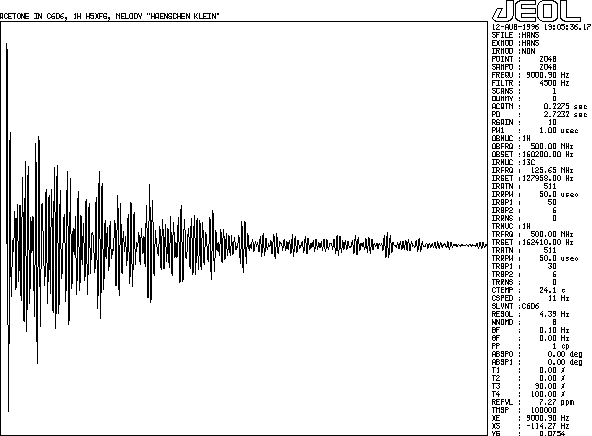
A very simple monophonic melody well known to all (German) children. For programming, the diatonic tuning was employed. In the pulse sequence, for each individual tone interval (prime, second, third etc.) the exact frequency difference between the carrier signal and the resonance line in the spectrum (acetone in CDCl3) is calculated by the pulse program. The merit of this method is that the song may be played in any arbitrary tune. The drawback is that we are restricted to using the diatonic tuning.

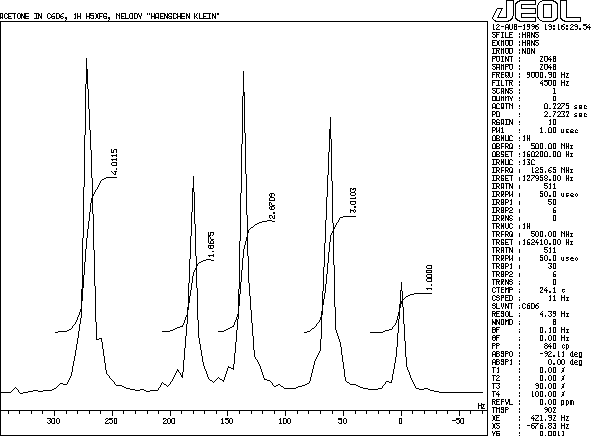
An interesting feature is seen in the Fourier-transformed spectrum of the summed-up FID. According to the five different tones in the song there are five distinct signals (the upper right one is the prime, the lower left one is the fifth). The integral of the individual signals reflects the abundance of the tones in the song. Remarkably, the prime is the least abundant tone whereas the fifth is the most abundant one. I checked some further simple children songs for the occurrence of tones — in most cases the fifth is the major abundant tone. Any plausible explanation by psychologists would be highly welcome!

Hänschen klein FID
FID
Hänschen klein spectrum
spectrum (five distinct tones)

“Dr. Schiwago” (balalaika-style, tempered tuning)

An even more realistic emulation of chords on an NMR spectrometer may be achieved by successive playing of tones like it’s done on a mandolin or a balalaika. Repeated short-spaced excitations of, e.g., the prime and the third are carried out over a longer period, e.g. one full bar of the song. As in the previous cases this requires the employment of a sample consisting of only a single resonance line (acetone in CDCl3).

Differing to the previous melodies, this song is played by using the tempered tuning with all intervals between successive half tones being equally spaced by a factor of 12√2. The offset frequency intervals are no longer calculated by the program itself due to principal reasons. Instead, a frequency list is employed which extends to more than 700 individual tones. Programming was achieved by first typing the tones of the song using an arbitrary abbreviation like FC1 or FE1 for the tones. “F” stands for frequency, C1 and E1 etc. stand for the tones in the melody if the song were played in C major. Subsequently, all symbols FC1, FE1 etc. were replaced with the appropriate exact frequencies using the pulse program editor. The drawback of this method is that the song may no longer be played in any arbitrary tune but is restricted to a fixed tune.

A “Happy birthday to you” chord-style melody was part of the original 1996 article. The audio for that example was not preserved in the Wayback snapshot and could not be recovered.

6. What does “MUSICIANS” mean?

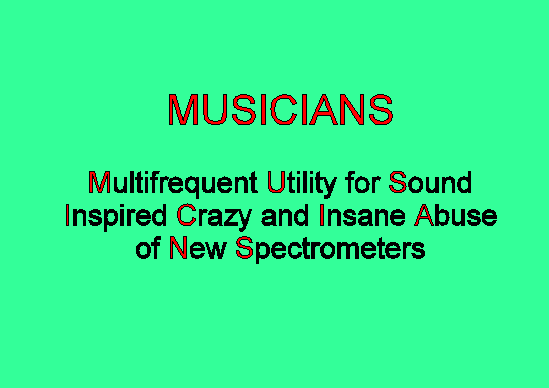
In modern NMR spectroscopy, pulse sequences are given acronyms. For example, COSY means COrrelation SpectroscopY, or INEPT means Insensitive Nuclei Enhanced by Polarization Transfer. There are even more sophisticated examples: INADEQUATE, NOESY, ROESY, TOCSY, HOHAHA, DEPT, APT, etc.

In the same tradition, the pulse sequences underlying the melodies presented here have an acronym:

MUSICIANS acronym definition

“MUSICIANS” pulse sequences may be downloaded with the individual melody files.

7. Conclusions

In this article I have tried to show that auditory FID presentation is a versatile tool for obtaining more detailed information on NMR spectra. In certain cases, the additional acoustic information may reveal special features which are not perceivable in an optical presentation. For example, the detection of artifacts in routine FIDs has been improved significantly in our lab since we introduced acoustic monitoring. The detection of errors in pulse programs is greatly facilitated.

Apart from these scientific applications, the demonstration that an NMR spectrometer is able to “play music” is striking proof that NMR signals indeed are pure ground tones obtained from oscillating nuclei. NMR thus may be presented to non-scientists in an entertaining way which arouses curiosity and may stimulate further interest in the subject.

Any feedback on this article is highly appreciated. Please note that the original author’s email (bauer@organik.uni-erlangen.de) no longer exists.

8. References and Links

The original article referenced a number of additional NMR resources. Many are now dead or moved; equivalents we still host or trust:

About this rescue

Original article: Walter Bauer, Institute of Organic Chemistry, University of Erlangen-Nuremberg (now FAU Erlangen-Nürnberg), 1996. Copyright © 1996 Walter Bauer.

Why this copy exists: Erlangen merged into FAU and the original page disappeared from the institute’s server during the migration. The author retired, the lab dispersed, and the only remaining copies of the article and its audio files live in the Internet Archive. We host this preservation copy so the material remains accessible to chemistry educators and students.

Source snapshot: Internet Archive Wayback Machine, 1998-02-13.

What we changed:

  • Collapsed the original 20-page navigable article into a single scrollable page with section anchors in the sidebar.
  • Audio files re-encoded losslessly from the original 8–16 kHz / 16-bit PCM WAV to FLAC (~39% of original size, native browser playback, identical fidelity). Original .aiff and .ra formats dropped as obsolete; FLAC supersedes both.
  • Updated HTML to current accessibility/typography conventions: removed deprecated table-based layout, broken Chime/Java applets, frame nav, and visitor-counter widgets.
  • Replaced links to obsolete companion pages where a working modern equivalent exists; removed where it doesn’t.
  • One audio file (“Happy birthday to you”) was not preserved in the Wayback snapshot and could not be recovered.

Restoration request: If you are the author or hold rights to this material and want it taken down or modified, please contact us via the OCD contact form.