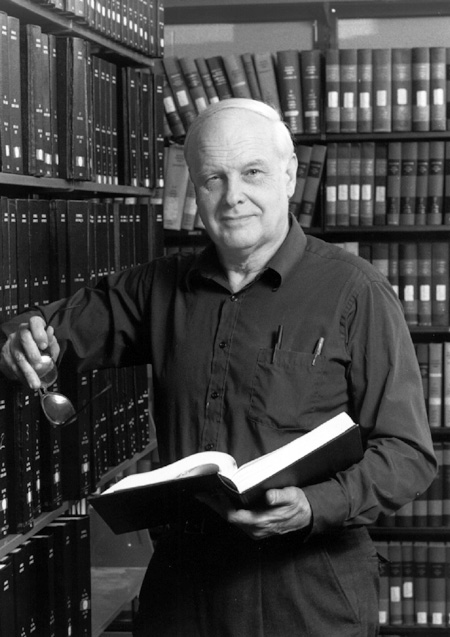
1931 – 2026
Professor Emeritus, Department of Chemistry
Michigan State University
William H. Reusch — Reusch Collection
About Professor William H. Reusch
Professor William Henry Reusch devoted his life to chemistry, education, and the belief that knowledge should be shared freely. Long after most professors would have stepped away from academia, he continued to walk the halls of Michigan State University, spending quiet hours in his department office, attending seminars simply for the joy of learning, and exchanging ideas with colleagues and friends. Retirement, for Bill, was never an ending. It was an opportunity to continue building.
Education and early career
Born in 1931, Reusch's scientific journey began at the University of Michigan, where he earned a B.S. in Chemistry in 1953. He completed his doctoral work in 1957 at Columbia University under renowned chemist Gilbert Stork. He was an NSF Fellow (1957–58) at Imperial College, London, with Derek Barton, and an NIH Fellow (1965–66) at Stanford University with Carl Djerassi.
His early research focused on organic synthesis, strained-ring compounds, and novel materials chemistry. Over the decades, he guided dozens of graduate students and became known not only as a skilled scientist but also as a patient and deeply thoughtful teacher. His research interests included:
- The development of new synthetic procedures and the application of these and other conventional methods to the synthesis of natural products or their analogs.
- Using readily available compounds, both natural and manufactured, to prepare novel materials — for example, polyesters (either alone or as blends with polyethers) as components of polymer electrolytes; and poly-3-hydroxyalkanoates, natural polyesters that appear ideal for that purpose.
In general, this kind of work requires skilled experimentalists who have a broad knowledge of reactions, are well-versed in separation techniques, and can apply a variety of spectroscopic measurements to the characterization of new compounds.1
An introduction to organic chemistry — on paper, then on the web
In 1977, Bill published An Introduction to Organic Chemistry, a traditional textbook written in an era when publishing was slow and errors were difficult to correct once a book reached print. That experience stayed with him. Years later, as digital technology began reshaping education, Reusch saw a new possibility: a living textbook that could evolve, improve, and remain accessible to anyone willing to learn. In the introduction to that book, he acknowledged a number of people — including Ronald Starkey, Peter Yates, Basil Wood, and Frank Lambert, and his wife Rosetta (Rose) Reusch — who were particularly helpful.
Within the textbook, Reusch shared his philosophy for teaching organic chemistry:
The study of organic chemistry is in many respects similar to the study of a foreign language. There is, for example, a new vocabulary of terms and symbols. Indeed, reaction equations are essentially sentences describing the consequences of certain experimental operations. As with a language, most of what you learn will be used constantly thereafter. You must therefore try to acquire a firm foundation of fact and principle through a regular program of study and practice (problem solving).
Notably, chapter one of the textbook introduces combustion analysis and mass spectroscopy for determining molecular formulas, followed by infrared spectroscopy and proton nuclear magnetic resonance (NMR) spectra to explain structural formulas — including isomers such as dimethyl ether and ethanol.
When he retired from Michigan State University in 2001 after more than forty years of teaching, many people expected him to slow down. Instead, he taught himself computer programming and began creating online organic chemistry problem sets.2
The Virtual Textbook of Organic Chemistry
What began as a small collection of interactive organic chemistry problems gradually grew into something remarkable — the Virtual Textbook of Organic Chemistry. In 2021, Bill described the project in his own words:4
In my 42 years at Michigan State University, I taught both undergraduate and graduate courses in organic chemistry. During office hours, students would often ask for a direct answer to one of the assigned problems. Instead of just answering the question, I would try to get students to respond to simple queries that would eventually lead to an answer. This means you need to have an interactive relationship. You don't normally get that on the computer, but I wanted to try to do that with my questions. Most chemistry problems available online at the time were simple flashcard-type problems with a question and an answer. My interactive problems had multiple parts and provided feedback as a user progressed, intending to mimic the interaction of a student with a teacher. Comments from users suggested that an explanation of the concepts behind the problems would be helpful, and the Virtual Text was born.
The resulting text content slowly evolved to occupy most of the site. I decided to provide layers of treatment, so a student could begin using the site as a novice, dig deeper for more information, and eventually find it useful as a graduate student. Users from universities all over the world provided feedback on the site. These comments have helped keep the text relatively error free. Although several universities and community colleges have used the Virtual Text for their students, the site is not organized to function as a true textbook and served primarily as an adjunct for conventional textbooks.
Security concerns associated with the use of Java applets have resulted in the failure of most browsers to display the original molecular editor and Jmol models that were an essential part of the Virtual Text. Fortunately, a group of dedicated programmers associated with the Organic Division of the American Chemical Society have chosen to rescue and restore this site before it fades away. I am grateful for their effort.
At a time when textbook prices were rapidly increasing, Reusch quietly created an alternative. Students could study aromaticity, alcohols, amines, reaction mechanisms, and spectroscopy without paying hundreds of dollars for a commercial textbook. Professors could adapt the material, reorganize chapters, and integrate it into their own teaching. Reusch believed that education worked best when barriers were removed.
He often described the project modestly, saying that after retirement he simply wanted "to keep busy doing something." But colleagues and students recognize the significance of what he had built. His work became part of the growing open-education movement and is praised not only for its accessibility, but for its clarity and depth.
Perhaps the most striking part of the story was how personally invested he remained in the project well into his nineties. Even decades after retirement, he continued revising chapters, updating content, and corresponding with educators who maintained and modernized the site. In emails to collaborators, he remained encouraging, curious, and generous. When portions of the site developed technical problems during the transition from older molecular applets to modern formats, Reusch immediately offered help, noting that he still had complete working files stored on his home computer and would gladly provide replacements.
He never treated the textbook as his possession alone. When a major educational publisher later approached him with an offer to purchase the content for a commercial platform, Reusch declined. He preferred seeing the work remain in the hands of the chemistry education community rather than turned over to "unknown authors." The openness of the project mattered to him as much as the chemistry itself. In 2022, he wrote the Organic Division web team leader: "Also, I am quite pleased to see it in the hands of the organic chemistry division of ACS."
A life of teaching, learning, and generosity
Those who knew Bill remember more than his scientific accomplishments. They remember a professor who continued coming to campus simply because he loved learning. They remember discussions about science, education, politics, and society shared between colleagues in department offices. They remember his humility, his precision, and the care he showed students and collaborators alike.
William Reusch passed away peacefully on May 3, 2026, at the age of ninety-four.3 By then, generations of students across the world had learned organic chemistry through the materials he created. His legacy lives not only in publications or research accomplishments, but in countless learners who encountered chemistry through a freely shared webpage, an interactive problem, or a carefully written explanation from a professor who believed education should be open to everyone.
For many educators, retirement marks the conclusion of a career. For Bill Reusch, it became the beginning of one of his most enduring contributions.
Sources
- Adapted in part from an archived copy of Professor Reusch's Michigan State University Graduate Office page, Internet Archive, 2004.
- Matthew Miller, “Retiree writes free online textbook,” Lansing State Journal, 29 March 2010.
- William H. Reusch obituary, Lansing State Journal, May 2026.
- William H. Reusch, personal communication to Brian Myers, ACS Division of Organic Chemistry web team leader, 2021.
The portrait above is from the archived copy of Professor Reusch's Michigan State University Graduate Office page (Internet Archive, 2004).