Isomer Properties
Properties of Constitutional Isomers
A striking example of the different properties that constitutional isomers may have is found in the C21H30O2 compounds progesterone and Δ1-tetrahydrocannabinol (THC). Structural formulas for these two naturally occurring chiral isomers are presented in the following diagram.
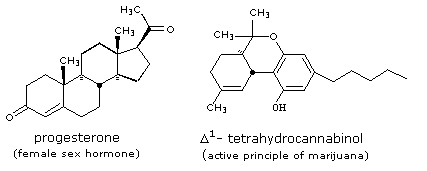
The diketone progesterone is a crystalline solid, having a melting point
127-130 ºC. Tetrahydrocannabinol, on the other hand, is a liquid phenolic
ether. Both compounds have a trisubstituted carbon-carbon double bond, but
the chemical reactions of progesterone reflect its carbonyl functions;
whereas, the reactions of THC are typical of a hindered phenol and a
3º-alkyl ether. The physiological properties of these compounds are
dramatically different; progesterone acting as a hormone and THC as a
hallucinogen. Interestingly, THC is nearly twice as toxic to female rats as
to males. Three dimensional models of these isomers may be examined
below.
It should be noted that, in contrast to constitutional isomers,
stereoisomers are more likely to have similar properties, and that
enantiomers (mirror image stereoisomers) will have identical properties
when tested by symmetrical probes (e.g. melting point or reactivity with
bromine).
Progesterone |
Δ1-Tetrahydrocannabinol |
|
|---|---|---|
|
Show Spacefill Model
Show Stick Model Show Ball&Stick Model |
Show Spacefill Model
Show Stick Model Show Ball&Stick Model |