HomeReuschVirtual Textbook SpectroscopyMass Spectrometry Additional Info

Mass Spectrometry Additional Info

EI-MassSpectra of Assorted Organic Compounds

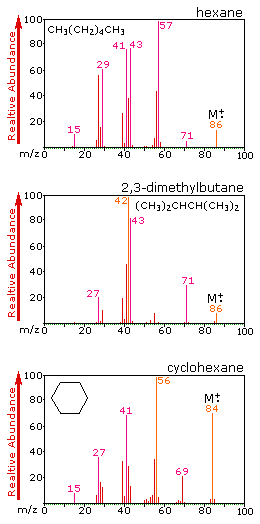
The mass apectra of three different saturated hydrocarbons are displayed below. Two are isomeric hexanes and the third is cyclohexane. Comments regarding the fragmentation patterns are presented in the box to the right of each spectrum. Ions are sometimes characterized by loss of a specific neutral fragment from the molecular ion. For example, a M-15 ion is identified as loss of a methyl group. Odd-electron ions, including the molecular ion, are colored orange when marked. Even-electron ions are colored magenta. The "Toggle Examples" button at the bottom will display a different set of spectra in which the influence of a particular functional group may be examined. Repeated clicking of this button will cycle through fifteeen spectra. In each example the molecular ion is designated by M •+.
Virtual Textbook: Spectroscopy — Mass Spectrometry Additional Info, figure 1

Common Fragment Ions and Neutral Fragments

Common Small Ions
m/zcomposition
15 DaCH3
17OH
18H2O
19H3O, F
26C2H2, CN
27C2H3
28C2H4, CO, H2CN
29C2H5, CHO
30CH2NH2
31CH3O
33SH, CH2F
34H2S
35(37)Cl
36(38)HCl
39C3H3
41C3H5, C2H3N
42C3H6, C2H2O, C2H4N
43C3H7, CH3CO
44C2H4O
46NO2
56C4H8
57C4H9
60CH4CO2
79(81)Br
80(82)HBr
91C7H7
127I
128HI
Common Neutral Fragments
mass losscomposition
1 DaH
15CH3
17OH
18H2O
19F
20HF
27C2H3, HCN
28C2H4, CO
30CH2O
31CH3O
32CH4O, S
33CH3 + H2O, HS
33H2S
35(37)Cl
36(38)HCl
42C3H6, C2H2O, C2H4N
43C3H7, CH3CO
44CO2O, CONH2
45C2H5O
55C4H7
57C4H9
59C2H3O2
60C2H4O2
64SO2
79(81)Br
80(82)HBr
127I
128HI

Rearangement Mechanisms in Fragmentation

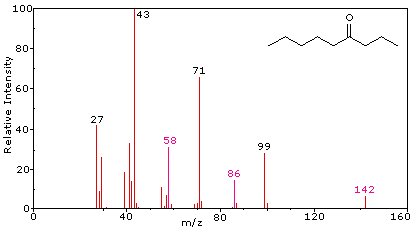
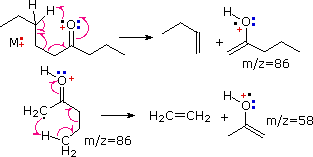
4-nonanone
Virtual Textbook: Spectroscopy — Mass Spectrometry Additional Info, figure 2

The odd-electron fragment ions at m/z = 86 and 58 are the result of a McLafferty rearrangement, involving the larger alkyl chain, and a subsequent loss of ethene (the "double-McLafferty" rearrangement).
Alpha-cleavage leads to the m/z = 99, 71 and 43 ions. The charge is apparently distributed over both fragments.
Virtual Textbook: Spectroscopy — Mass Spectrometry Additional Info, figure 3

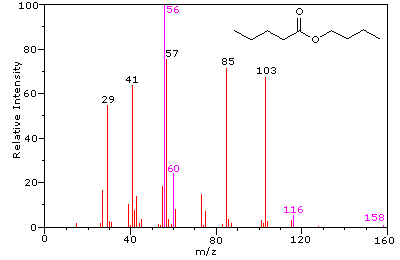
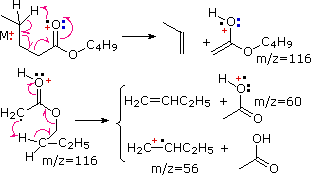
butylpentanoate
Virtual Textbook: Spectroscopy — Mass Spectrometry Additional Info, figure 4

Alpha-cleavage gives ions at m/z=57 & 85 Da. The McLafferty rearrangement on the acid side generates a m/z=116 ion. Subsequent rearrangement on the alcohol side generates m/z=60 and 56 ions. The m/z=103 ion is probably C4H9CO2H2(+).
Virtual Textbook: Spectroscopy — Mass Spectrometry Additional Info, figure 5

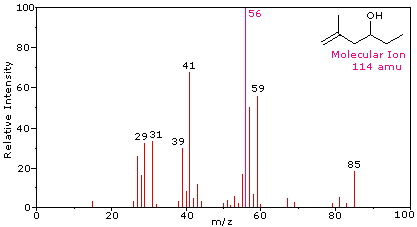
5-methyl-5-hexen-3-ol
Virtual Textbook: Spectroscopy — Mass Spectrometry Additional Info, figure 6


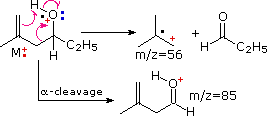
The molecular ion (m/z=114 Da) is not observed under electron impact ionization conditions. The highest mass ion (m/z=85) is due to an alpha-cleavage of ethyl; the other alpha-cleavage generates m/z=59. The rearrangement cleavage shown here generates the m/z=56 ion.
Virtual Textbook: Spectroscopy — Mass Spectrometry Additional Info, figure 7

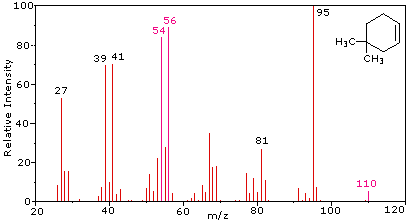
4,4-dimethylcyclohexene
Virtual Textbook: Spectroscopy — Mass Spectrometry Additional Info, figure 8


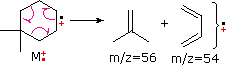
The loss of a methyl radical generates the base peak at m/z=95 Da. The m/z=81 & 67 ions are smaller homologues of this ion (14 mass units less). Cyclohexene compounds undergo a retro-Diel-Alder rearrangement to give diene and alkene fragments. The charge may reside on either fragment, with the larger usually predominating. In this case both ions are relatively strong (m/z=54 & 56).
Virtual Textbook: Spectroscopy — Mass Spectrometry Additional Info, figure 9