Reactions of Bromine with Selected Compounds
Bromine is a strong electrophile and has a characteristic red-brown
color. These properties make bromine a useful reagent for probing the
reactivity of colorless nucleophilic organic compounds, such as alkenes and
arenes. Two kinds of reaction are common: addition & substitution.
In an addition reaction to an alkene two covalent C-Br bonds are formed,
and the color of the bromine fades as the colorless product is generated.
In a substitution reaction of a hydrocarbon a C-Br covalent bond is also
formed, but this product is accompanied by release of of an equal molar
quantity of hydrogen bromide gas. HBr is a colorless gas, having a nasty
sharp, choking odor. The easiest way of detecting this gas is through its
rapid reaction with ammonia (also a gas), which generates a cloud of
ammonium bromide particles. The ammonia is conveniently introduced by way
of an adjacent beaker containing ammonium hydroxide solution.
The following unit provides a virtual demonstration of the reactions
(or lack of reaction) of bromine with a selected group of compounds.
Cyclohexane has no pi-unsaturation and is therefore not nucleophilic. It
does not react with bromine unless energy in the form of light or heat is
applied. In such a case a free-radical substitution reaction occurs.
Cyclohexene is a typical alkene, and benzene and anisole are aromatic
compounds. The methoxy substituent present in anisole increases the
nucleophilicity of the aromatic ring, and greatly enhances the reactivity
of the ring toward electrophilic attack. A small amount of the ortho
substituted product is also obtained from the bromination of anisole.
| Cyclohexane | Cyclohexene | Benzene | Anisole | 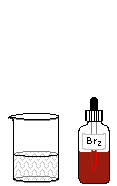 |
|---|---|---|---|---|
 |
||||
 |
||||
This page was scripted by William Reusch, Department of Chemistry,
Michigan State University
Comments, questions and errors should be sent to whreusch@pilot.msu.edu.