Visible and Ultraviolet Spectroscopy
1. Background
An obvious difference between certain compounds is their color. Thus,
quinone is yellow; chlorophyll is green; the 2,4-dinitrophenylhydrazone
derivatives of aldehydes and ketones range in color from bright yellow to
deep red, depending on double bond conjugation; and aspirin is colorless.
In this respect the human eye is functioning as a spectrometer analyzing
the light reflected from the surface of a solid or passing through a
liquid. Although we see sunlight (or white light) as uniform or homogeneous
in color, it is actually composed of a broad range of radiation wavelengths
in the ultraviolet (UV), visible and infrared (IR) portions of the
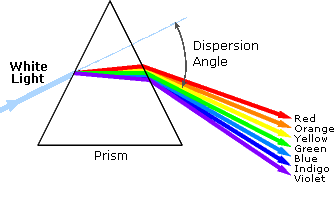
spectrum. As shown on the right, the component colors of the visible
portion can be separated by passing sunlight through a prism, which acts to
bend the light in differing degrees according to wavelength.
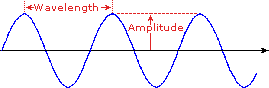
Electromagnetic radiation such as visible light is commonly treated as a
wave phenomenon, characterized by a wavelength or frequency.
Wavelength is defined on the left below, as the distance between
adjacent peaks (or troughs), and may be designated in meters, centimeters
or nanometers (10-9 meters). Frequency is the number of
wave cycles that travel past a fixed point per unit of time, and is usually
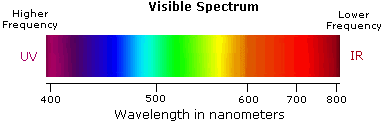
given in cycles per second, or hertz (Hz). Visible wavelengths cover a
range from approximately 400 to 800 nm. The longest visible wavelength is
red and the shortest is violet. Other common colors of the spectrum, in
order of decreasing wavelength, may be remembered by the mnemonic: ROY G
BIV. The wavelengths of what we perceive as particular colors in the
visible portion of the spectrum are displayed and listed below. In
horizontal diagrams, such as the one on the bottom left, wavelength will
increase on moving from left to right.
 |
|
 |
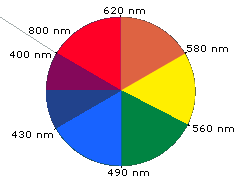
When white light passes through or is reflected by a colored substance,
a characteristic portion of the mixed wavelengths is absorbed. The
remaining light will then assume the complementary color to the
wavelength(s) absorbed. This relationship is demonstrated by the color
wheel shown on the right. Here, complementary colors are diametrically
opposite each other. Thus, absorption of 420-430 nm light renders a
substance yellow, and absorption of 500-520 nm light makes it red. Green is
unique in that it can be created by absoption close to 400 nm as well as
absorption near 800 nm.
Early humans valued colored pigments, and used them for decorative
purposes. Many of these were inorganic minerals, but several important
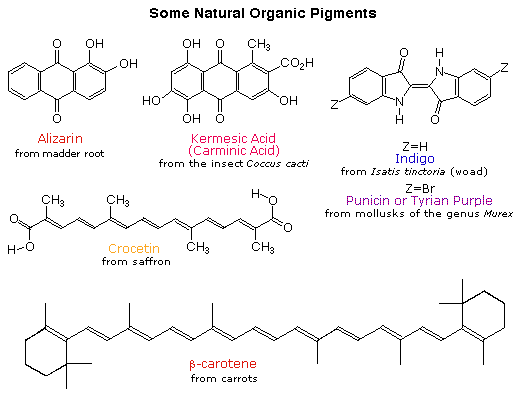
organic dyes were also known. These included the crimson pigment, kermesic
acid, the blue dye, indigo, and the yellow saffron pigment, crocetin. A
rare dibromo-indigo derivative, punicin, was used to color the robes of the
royal and wealthy. The deep orange hydrocarbon carotene is widely
distributed in plants, but is not sufficiently stable to be used as
permanent pigment, other than for food coloring. A common feature of all
these colored compounds, displayed below, is a system of extensively
conjugated pi-electrons.
2. The Electromagnetic Spectrum
The visible spectrum constitutes but a small part of the total radiation spectrum. Most of the radiation that surrounds us cannot be seen, but can be detected by dedicated sensing instruments. This electromagnetic spectrum ranges from very short wavelengths (including gamma and x-rays) to very long wavelengths (including microwaves and broadcast radio waves). The following chart displays many of the important regions of this spectrum, and demonstrates the inverse relationship between wavelength and frequency (shown in the top equation below the chart).
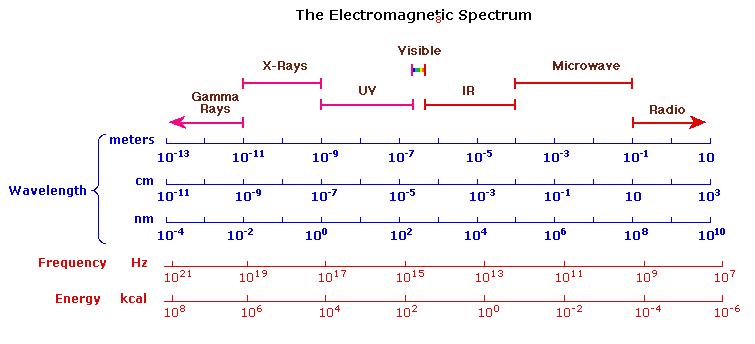
The energy associated with a given segment of the spectrum is proportional to its frequency. The bottom equation describes this relationship, which provides the energy carried by a photon of a given wavelength of radiation.

To obtain specific frequency, wavelength and energy values use this calculator.
3. UV-Visible Absorption Spectra
To understand why some compounds are colored and others are not, and to determine the relationship of conjugation to color, we must make accurate measurements of light absorption at different wavelengths in and near the visible part of the spectrum. Commercial optical spectrometers enable such experiments to be conducted with ease, and usually survey both the near ultraviolet and visible portions of the spectrum.
|
For a description of a UV-Visible spectrometer Click Here. |
|---|
The visible region of the spectrum comprises photon energies of 36 to 72 kcal/mole, and the near ultraviolet region, out to 200 nm, extends this energy range to 143 kcal/mole. Ultraviolet radiation having wavelengths less than 200 nm is difficult to handle, and is seldom used as a routine tool for structural analysis.
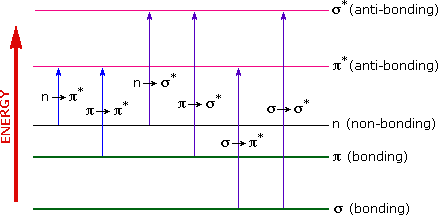
The energies noted above are sufficient to promote or excite a molecular
electron to a higher energy orbital. Consequently, absorption spectroscopy
carried out in this region is sometimes called "electronic spectroscopy". A
diagram showing the various kinds of electronic excitation that may occur
in organic molecules is shown on the left. Of the six transitions outlined,
only the two lowest energy ones (left-most, colored blue) are achieved by
the energies available in the 200 to 800 nm spectrum. As a rule,
energetically favored electron promotion will be from the highest
occupied molecular orbital (HOMO) to the lowest unoccupied molecular
orbital (LUMO), and the resulting species is called an excited
state. For a review of molecular orbitals click here.
When sample molecules are exposed to light having an energy that matches a
possible electronic transition within the molecule, some of the light
energy will be absorbed as the electron is promoted to a higher energy
orbital. An optical spectrometer records the wavelengths at which
absorption occurs, together with the degree of absorption at each
wavelength. The resulting spectrum is presented as a graph of absorbance
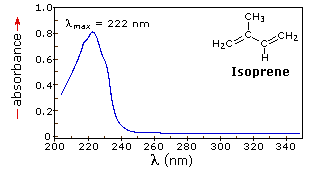
(A) versus wavelength, as in the isoprene spectrum shown below. Since
isoprene is colorless, it does not absorb in the visible part of the
spectrum and this region is not displayed on the graph. Absorbance
usually ranges from 0 (no absorption) to 2 (99% absorption), and is
precisely defined in context with spectrometer operation.
Because the absorbance of a sample will be proportional to the number of absorbing molecules in the spectrometer light beam (e.g. their molar concentration in the sample tube), it is necessary to correct the absorbance value for this and other operational factors if the spectra of different compounds are to be compared in a meaningful way. The corrected absorption value is called "molar absorptivity", and is particularly useful when comparing the spectra of different compounds and determining the relative strength of light absorbing functions (chromophores). Molar absorptivity (ε) is defined as:
|
Molar Absorptivity, ε = A / c l |
(where A= absorbance, c = sample concentration in moles/liter & l = length of light path through the sample in cm.) |
|---|
If the isoprene spectrum on the right was obtained from a dilute hexane solution (c = 4 * 10-5 moles per liter) in a 1 cm sample cuvette, a simple calculation using the above formula indicates a molar absorptivity of 20,000 at the maximum absorption wavelength. Indeed the entire vertical absorbance scale may be changed to a molar absorptivity scale once this information about the sample is in hand. Clicking on the spectrum will display this change in units.
|
 |
From the chart above it should be clear that the only molecular moieties
likely to absorb light in the 200 to 800 nm region are pi-electron
functions and hetero atoms having non-bonding valence-shell electron pairs.
Such light absorbing groups are referred to as chromophores. A list
of some simple chromophores and their light absorption characteristics is
provided on the left above. The oxygen non-bonding electrons in alcohols
and ethers do not give rise to absorption above 160 nm. Consequently, pure
alcohol and ether solvents may be used for spectroscopic studies.
The presence of chromophores in a molecule is best documented by UV-Visible
spectroscopy, but the failure of most instruments to provide absorption
data for wavelengths below 200 nm makes the detection of isolated
chromophores problematic. Fortunately, conjugation generally moves the
absorption maxima to longer wavelengths, as in the case of isoprene, so
conjugation becomes the major structural feature identified by this
technique.
Molar absorptivities may be very large for strongly absorbing chromophores
(>10,000) and very small if absorption is weak (10 to 100). The
magnitude ofε reflects both the size of the chromophore and the probability
that light of a given wavelength will be absorbed when it strikes the
chromophore.
|
For further discussion of this topic Click Here. |
|---|
4. The Importance of Conjugation
A comparison of the absorption spectrum of 1-pentene, λmax =
178 nm, with that of isoprene (above) clearly demonstrates the importance
of chromophore conjugation. Further evidence of this effect is shown below.
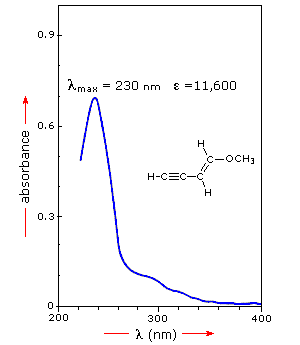
The spectrum on the left illustrates that conjugation of double and triple
bonds also shifts the absorption maximum to longer wavelengths. From the
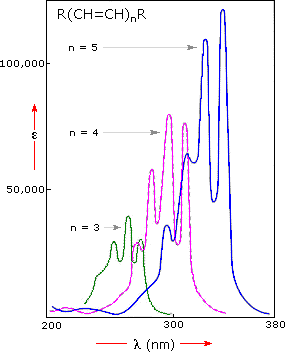
polyene spectra displayed in the center diagram, it is clear that each
additional double bond in the conjugated pi-electron system shifts the
absorption maximum about 30 nm in the same direction. Also, the molar
absorptivity (ε) roughly doubles with each new conjugated double bond.
Spectroscopists use the terms defined in the table on the right when
describing shifts in absorption. Thus, extending conjugation generally
results in bathochromic and hyperchromic shifts in absorption.
The appearance of several absorption peaks or shoulders for a given
chromophore is common for highly conjugated systems, and is often solvent
dependent. This fine structure reflects not only the different
conformations such systems may assume, but also electronic transitions
between the different vibrational energy levels possible for each
electronic state. Vibrational fine structure of this kind is most
pronounced in vapor phase spectra, and is increasingly broadened and
obscured in solution as the solvent is changed from hexane to methanol.
 |
 |
Terminology for Absorption Shifts
|
|---|
To understand why conjugation should cause bathochromic shifts in the
absorption maxima of chromophores, we need to look at the relative energy
levels of the pi-orbitals. When two double bonds are conjugated, the four
p-atomic orbitals combine to generate four pi-molecular orbitals (two are
bonding and two are antibonding). This was described
earlier in the section concerning diene chemistry. In a similar manner,
the three double bonds of a conjugated triene create six pi-molecular
orbitals, half bonding and half antibonding. The energetically most
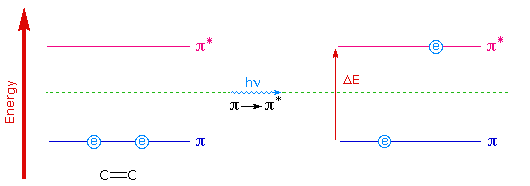
favorable π __> π* excitation occurs from the highest
energy bonding pi-orbital (HOMO) to the lowest energy antibonding
pi-orbital (LUMO).
The following diagram illustrates this excitation for an isolated double
bond (only two pi-orbitals) and, on clicking the diagram, for a
conjugated diene and triene. In each case the HOMO is colored blue and the
LUMO is colored magenta. Increased conjugation brings the HOMO and LUMO
orbitals closer together. The energy (ΔE) required to effect the electron
promotion is therefore less, and the wavelength that provides this energy
is increased correspondingly (rememberλ = h •
c/ΔE ).
 |
|
Examples of π __> π* Excitation |
|---|
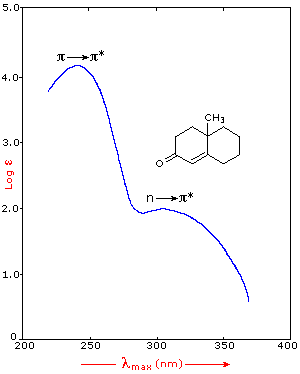
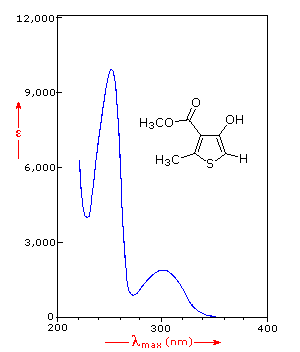
Many other kinds of conjugated pi-electron systems act as chromophores and absorb light in the 200 to 800 nm region. These include unsaturated aldehydes and ketones and aromatic ring compounds. A few examples are displayed below. The spectrum of the unsaturated ketone (on the left) illustrates the advantage of a logarithmic display of molar absorptivity. The π __> π* absorption located at 242 nm is very strong, with an ε = 18,000. The weak n __> π* absorption near 300 nm has an ε = 100.
 |
 |
|---|
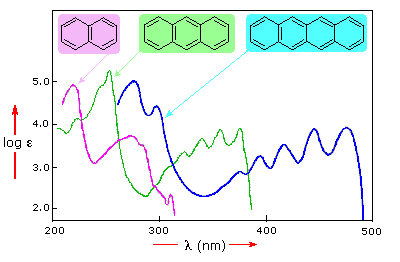
Benzene exhibits very strong light absorption near 180 nm (ε > 65,000) , weaker absorption at 200 nm (ε = 8,000) and a group of much weaker bands at 254 nm (ε = 240). Only the last group of absorptions are completely displayed because of the 200 nm cut-off characteristic of most spectrophotometers. The added conjugation in naphthalene, anthracene and tetracene causes bathochromic shifts of these absorption bands, as displayed in the chart on the left below. All the absorptions do not shift by the same amount, so for anthracene (green shaded box) and tetracene (blue shaded box) the weak absorption is obscured by stronger bands that have experienced a greater red shift. As might be expected from their spectra, naphthalene and anthracene are colorless, but tetracene is orange.
 |
 |
|---|
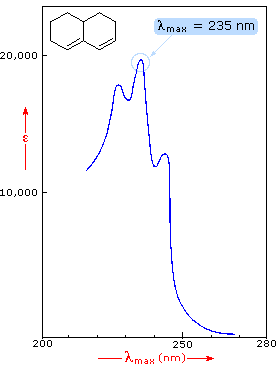
The spectrum of the bicyclic diene (above right) shows some vibrational fine structure, but in general is similar in appearance to that of isoprene, shown above. Closer inspection discloses that the absorption maximum of the more highly substituted diene has moved to a longer wavelength by about 15 nm. This "substituent effect" is general for dienes and trienes, and is even more pronounced for enone chromophores.
|
A set of empirical rules for predicting the λmax of
such chromophores has been developed. |
|---|