Ring Conformers
Ring Conformations
Although the customary line drawings of simple cycloalkanes are geometrical polygons, the actual shape of these compounds in most cases is very different.
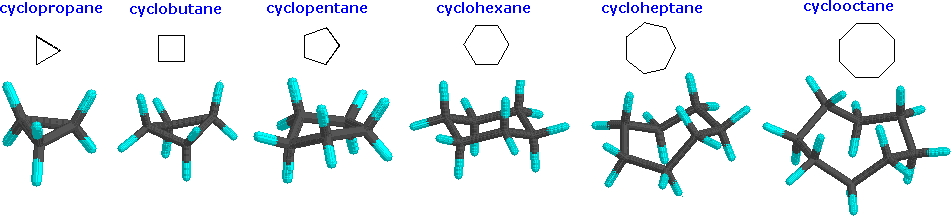
Cyclopropane is necessarily planar (flat), with the carbon atoms at the corners of an equilateral triangle. The 60º bond angles are much smaller than the optimum 109.5º angles of a normal tetrahedral carbon atom, and the resulting angle strain dramatically influences the chemical behavior of this cycloalkane. Cyclopropane also suffers substantial eclipsing strain, since all the carbon-carbon bonds are fully eclipsed. Cyclobutane reduces some bond-eclipsing strain by folding (the out-of-plane dihedral angle is about 25º), but the total eclipsing and angle strain remains high. Cyclopentane has very little angle strain (the angles of a pentagon are 108º), but its eclipsing strain would be large (about 10 kcal/mol) if it remained planar. Consequently, the five-membered ring adopts non-planar puckered conformations whenever possible. Rings larger than cyclopentane would have angle strain if they were planar. However, this strain, together with the eclipsing strain inherent in a planar structure, can be relieved by puckering the ring. Cyclohexane is a good example of a carbocyclic system that virtually eliminates eclipsing and angle strain by adopting non-planar conformations, such as those shown below. Cycloheptane and cyclooctane have greater strain than cyclohexane, in large part due to transannular crowding (steric hindrance by groups on opposite sides of the ring).
Some Conformations of Cyclohexane Rings
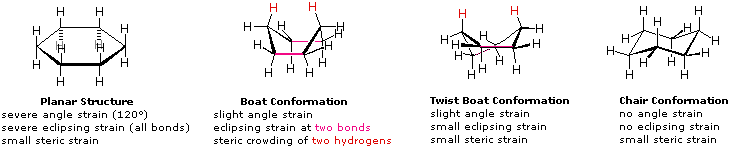
A planar structure for cyclohexane is clearly improbable. The bond
angles would necessarily be 120º, 10.5º larger than the ideal tetrahedral
angle. Also, every carbon-carbon bond in such a structure would be
eclipsed. The resulting angle and eclipsing strains would severely
destabilize this structure. If two carbon atoms on opposite sides of the
six-membered ring are lifted out of the plane of the ring, much of the
angle strain can be eliminated. This boat structure still has two
eclipsed bonds (colored magenta in the drawing) and severe steric crowding
of two hydrogen atoms on the "bow" and "stern" of the boat. This steric
crowding is often called steric hindrance. By twisting the boat
conformation, the steric hindrance can be partially relieved, but the
twist-boat conformer still retains some of the strains that
characterize the boat conformer. Finally, by lifting one carbon above the
ring plane and the other below the plane, a relatively strain-free chair
conformer is formed. This is the predominant structure adopted by
molecules of cyclohexane.
An energy diagram for these conformational interconversions is drawn below.
The activation energy for the chair-chair conversion is due chiefly to a
high energy twist-chair form (TC), in which significant angle and eclipsing
strain are present. A facile twist-boat (TB)-boat (B) equilibrium
intervenes as one chair conformer (C) changes to the other.
Conformational Energy Profile of Cyclohexane |
||
|---|---|---|
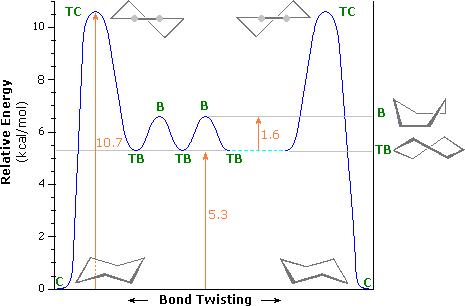 |
TC = twist chair | |
| B = boat | ||
| TB = twist boat | ||
| C = chair |
These conformations may be examined as interactive models by .
Investigations concerning the conformations of cyclohexane were
initiated by H. Sachse (1890) and E. Mohr (1918), but it was not until 1950
that a full treatment of the manifold consequences of interconverting chair
conformers and the different orientations of pendent bonds was elucidated
by D. H. R. Barton (Nobel Prize 1969
together with O. Hassel). The following discussion presents some of the
essential features of this conformational analysis.
On careful examination of a chair conformation of cyclohexane, we find that
the twelve hydrogens are not structurally equivalent. Six of them are
located about the periphery of the carbon ring, and are termed
equatorial. The other six are oriented above and below the
approximate plane of the ring (three in each location), and are termed
axial because they are aligned parallel to the symmetry axis of the
ring. In the stick model shown on the left below, the equatorial hydrogens
are colored blue, and the axial hydrogens are red. Since there are two
equivalent chair conformations of cyclohexane in rapid equilibrium, all
twelve hydrogens have 50% equatorial and 50% axial character.
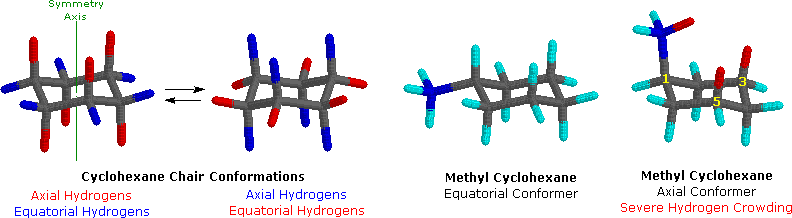
Because axial bonds are parallel to each other, substituents larger than hydrogen generally suffer greater steric crowding when they are oriented axial rather than equatorial. Consequently, substituted cyclohexanes will preferentially adopt conformations in which large substituents assume equatorial orientation. In the two methylcyclohexane conformers shown above, the methyl carbon is colored blue. When the methyl group occupies an axial position it suffers steric crowding by the two axial hydrogens located on the same side of the ring. This crowding or steric hindrance is associated with the red-colored hydrogens in the structure. A careful examination of the axial conformer shows that this steric hindrance is due to two gauche-like orientations of the methyl group with ring carbons #3 and #5. The use of models is particularly helpful in recognizing and evaluating these relationships.
These conformations may be examined as interactive models by
To view an animation of the interconversion of cyclohexane chair conformers
The relative steric hindrance experienced by different substituent
groups oriented in an axial versus equatorial location on cyclohexane may
be determined by the conformational equilibrium of the compound. The
corresponding equilibrium constant is related to the energy
difference between the conformers, and collecting such data allows us
to evaluate the relative tendency of substituents to exist in an equatorial
or axial location. A table of these free energy values (sometimes referred
to as A values) may be examined by .
Clearly the apparent "size" of a substituent is influenced by its width and
bond length to cyclohexane, as evidenced by the fact that an axial vinyl
group is less hindered than ethyl, and iodine slightly less than
chlorine.
Substituted Cyclohexanes
Substituted Cyclohexane Compounds
Because it is so common among natural and synthetic compounds, and
because its conformational features are rather well understood, we shall
focus on the six-membered cyclohexane ring in this discussion. In a sample
of cyclohexane, the two identical chair conformers are present in equal
concentration, and the hydrogens are all equivalent (50% equatorial &
50% axial) due to rapid interconversion of the conformers. When the
cyclohexane ring bears a substituent, the two chair conformers are not the
same. In one conformer the substituent is axial, in the other it is
equatorial. Due to steric hindrance in the axial location, substituent
groups prefer to be equatorial and that chair conformer predominates in the
equilibrium.
We noted earlier that cycloalkanes having two or more substituents on
different ring carbon atoms exist as a pair (sometimes more) of
configurational stereoisomers. Now we must examine the way in which
favorable ring conformations influence the properties of the
configurational isomers. Remember, configurational stereoisomers are stable
and do not easily interconvert, whereas, conformational isomers normally
interconvert rapidly. In examining possible structures for substituted
cyclohexanes, it is useful to follow two principles.
(i) Chair conformations are generally more stable than other
possibilities.
(ii) Substituents on chair conformers prefer to occupy equatorial
positions due to the increased steric hindrance of axial locations.
The following equations and formulas illustrate how the presence of two or more substituents on a cyclohexane ring perturbs the interconversion of the two chair conformers in ways that can be predicted.
Conformational Structures of Disubstituted Cyclohexanes
| 1,1-dimethylcyclohexane | 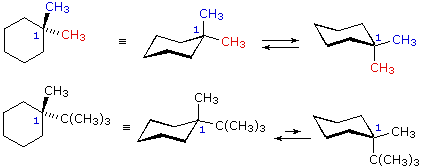 |
|---|---|
| 1-t-butyl-1-methylcyclohexane | |
| cis-1,2-dimethylcyclohexane | 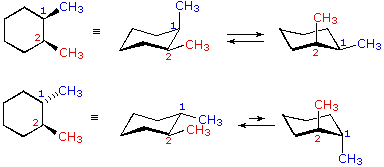 |
| trans-1,2-dimethylcyclohexane | |
| cis-1,3-dimethylcyclohexane | 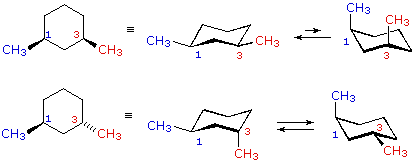 |
| trans-1,3-dimethylcyclohexane | |
| cis-1,4-dimethylcyclohexane | 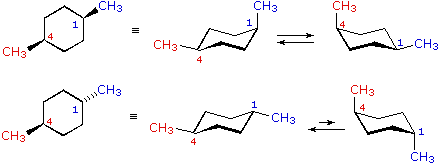 |
| trans-1,4-dimethylcyclohexane |
In the case of 1,1-disubstituted cyclohexanes, one of the substituents
must necessarily be axial and the other equatorial, regardless of which
chair conformer is considered. Since the substituents are the same in
1,1-dimethylcyclohexane, the two conformers are identical and present in
equal concentration. In 1-t-butyl-1-methylcyclohexane the t-butyl group is
much larger than the methyl, and that chair conformer in which the larger
group is equatorial will be favored in the equilibrium( > 99%).
Consequently, the methyl group in this compound is almost exclusively axial
in its orientation.
In the cases of 1,2-, 1,3- and 1,4-disubstituted compounds the analysis is
a bit more complex. It is always possible to have both groups equatorial,
but whether this requires a cis-relationship or a trans-relationship
depends on the relative location of the substituents. As we count around
the ring from carbon #1 to #6, the uppermost bond on each carbon changes
its orientation from equatorial (or axial) to axial (or equatorial) and
back. It is important to remember that the bonds on a given side of a
chair ring-conformation always alternate in this fashion. Therefore, it
should be clear that for cis-1,2-disubstitution, one of the substituents
must be equatorial and the other axial; in the trans-isomer both may be
equatorial. Because of the alternating nature of equatorial and axial
bonds, the opposite relationship is true for 1,3-disubstitution (cis is all
equatorial, trans is equatorial/axial). Finally, 1,4-disubstitution reverts
to the 1,2-pattern.
The conformations of some substituted cyclohexanes may be examined as interactive models by .
|
For additional information about six-membered ring conformations Click Here. |
Practice Problems
These four problems concern the recognition of different conformations of a given constitutional structure. Axial and equatorial relationships of cyclohexane substituents are also examined.
Stereoisomers Part II
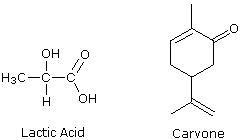 As chemists studied
organic compounds isolated from plants and animals, a new and subtle type
of configurational stereoisomerism was discovered. For example, lactic acid
( a C3H6O3 carboxylic acid) was found in
sour milk as well as in the blood and muscle fluids of animals. The
physical properties of this simple compound were identical, regardless of
the source (m.p, 53 ºC & pKa 3.80), but there was evidence
that the physiological behavior of the compound from the two sources was
not the same. Another natural product, the fragrant
C10H14O ketone carvone, was isolated from both
spearmint and caraway. Again, all the physical properties of carvone from
these two sources seemed to be identical (b.p. 230 ºC), but the odors of
the two carvones were different and reflected their source. Other examples
of this kind were encountered, and suspicions of a subtle kind of
stereoisomerism were confirmed by the different interaction these compounds
displayed with plane polarized light. We now know that this configurational
stereoisomerism is due to different right and left-handed forms that
certain structures may adopt, in much the same way that a screw may have
right or left-handed threads but the same overall size and shape. Isomeric
pairs of this kind are termed enantiomers (from the Greek
enantion meaning opposite).
As chemists studied
organic compounds isolated from plants and animals, a new and subtle type
of configurational stereoisomerism was discovered. For example, lactic acid
( a C3H6O3 carboxylic acid) was found in
sour milk as well as in the blood and muscle fluids of animals. The
physical properties of this simple compound were identical, regardless of
the source (m.p, 53 ºC & pKa 3.80), but there was evidence
that the physiological behavior of the compound from the two sources was
not the same. Another natural product, the fragrant
C10H14O ketone carvone, was isolated from both
spearmint and caraway. Again, all the physical properties of carvone from
these two sources seemed to be identical (b.p. 230 ºC), but the odors of
the two carvones were different and reflected their source. Other examples
of this kind were encountered, and suspicions of a subtle kind of
stereoisomerism were confirmed by the different interaction these compounds
displayed with plane polarized light. We now know that this configurational
stereoisomerism is due to different right and left-handed forms that
certain structures may adopt, in much the same way that a screw may have
right or left-handed threads but the same overall size and shape. Isomeric
pairs of this kind are termed enantiomers (from the Greek
enantion meaning opposite).
Chirality
Chirality and Symmetry
All objects may be classified with respect to a property we call chirality (from the Greek cheir meaning hand). A chiral object is not identical in all respects (i.e. superimposable) with its mirror image. An achiral object is identical with (superimposable on) its mirror image. Chiral objects have a "handedness", for example, golf clubs, scissors, shoes and a corkscrew. Thus, one can buy right or left-handed golf clubs and scissors. Likewise, gloves and shoes come in pairs, a right and a left. Achiral objects do not have a handedness, for example, a baseball bat (no writing or logos on it), a plain round ball, a pencil, a T-shirt and a nail. The chirality of an object is related to its symmetry, and to this end it is useful to recognize certain symmetry elements that may be associated with a given object. A symmetry element is a plane, a line or a point in or through an object, about which a rotation or reflection leaves the object in an orientation indistinguishable from the original. Some examples of symmetry elements are shown below.
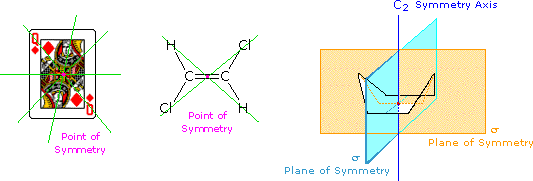
The face playing card provides an example of a center or point of
symmetry. Starting from such a point, a line drawn in any direction
encounters the same structural features as the opposite (180º) line. Four
random lines of this kind are shown in green. An example of a molecular
configuration having a point of symmetry is (E)-1,2-dichloroethene. Another
way of describing a point of symmetry is to note that any point in the
object is reproduced by reflection through the center onto the other side.
In these two cases the point of symmetry is colored magenta.
The boat conformation of cyclohexane shows an axis of symmetry (labeled
C2 here) and two intersecting planes of symmetry (labeled σ).
The notation for a symmetry axis is Cn, where n is an integer
chosen so that rotation about the axis by 360/nº returns the object to a
position indistinguishable from where it started. In this case the rotation
is by 180º, so n=2. A plane of symmetry divides the object in such a way
that the points on one side of the plane are equivalent to the points on
the other side by reflection through the plane. In addition to the point of
symmetry noted earlier, (E)-1,2-dichloroethene also has a plane of symmetry
(the plane defined by the six atoms), and a C2 axis, passing
through the center perpendicular to the plane. The
existence of a reflective symmetry element (a point or plane of symmetry)
is sufficient to assure that the object having that element is
achiral. Chiral objects, therefore, do not have any
reflective symmetry elements, but may have rotational symmetry axes, since
these elements do not require reflection to operate. In addition to the
chiral vs achiral distinction, there are two other terms often used to
refer to the symmetry of an object. These are:
(i) Dissymmetry: The absence of reflective symmetry elements.
All dissymmetric objects are chiral.
(ii) Asymmetry: The absence of all symmetry elements. All
asymmetric objects are chiral.
Models of some additional three-dimensional examples are provided on the interactive symmetry page.
|
The symmetry elements of a structure provide insight concerning
the structural |
George Hart has produced a nice treatment of symmetry in polyhedra that makes use of VRML. To view this siteClick Here
Enantiomorphism
Enantiomorphism
A consideration of the chirality of molecular configurations explains
the curious stereoisomerism observed for lactic acid, carvone and a
multitude of other organic compounds. Tetravalent carbons have a
tetrahedral configuration. If all four substituent groups are the same, as
in methane or tetrachloromethane, the configuration is that of a highly
symmetric "regular tetrahedron". A regular tetrahedron has six planes of
symmetry and seven symmetry axes (four C3 & three
C2) and is, of course, achiral. Examples of
these Axes and Planes are found on George Hart's VRML
site.
If one of the carbon substituents is different from the other three, the
degree of symmetry is lowered to a C3 axis and three planes of
symmetry, but the configuration remains achiral. The tetrahedral
configuration in such compounds is no longer regular, since bond lengths
and bond angles change as the bonded atoms or groups change. Further
substitution may reduce the symmetry even more, but as long as two of the
four substituents are the same there is always a plane of symmetry that
bisects the angle linking those substituents, so these configurations are
also achiral.
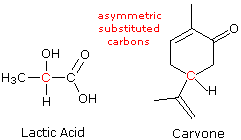 A carbon atom that is
bonded to four different atoms or groups loses all symmetry, and is often
referred to as an asymmetric carbon. The configuration of such a
molecular unit is chiral, and the structure may exist in either a
right-handed configuration or a left-handed configuration (one the mirror
image of the other). This type of configurational stereoisomerism is termed
enantiomorphism, and the non-identical, mirror-image pair of
stereoisomers that result are called enantiomers. The structural
formulas of lactic acid and carvone are drawn on the right with the
asymmetric carbon colored red. Consequently, we expect, and find, these
compounds to exist as pairs of enantiomers. The presence of a single
asymmetrically substituted carbon atom in a molecule is sufficient to
render the whole configuration chiral, and modern terminology refers to
such asymmetric (or dissymmetric) groupings as chiral centers. Most
of the chiral centers we shall discuss are asymmetric carbon atoms, but it
should be recognized that other tetrahedral or pyramidal atoms may become
chiral centers if appropriately substituted. When more than one chiral
center is present in a molecular structure, care must be taken to analyze
their relationship before concluding that a specific molecular
configuration is chiral or achiral. This aspect of stereoisomerism will be
treated later.
A carbon atom that is
bonded to four different atoms or groups loses all symmetry, and is often
referred to as an asymmetric carbon. The configuration of such a
molecular unit is chiral, and the structure may exist in either a
right-handed configuration or a left-handed configuration (one the mirror
image of the other). This type of configurational stereoisomerism is termed
enantiomorphism, and the non-identical, mirror-image pair of
stereoisomers that result are called enantiomers. The structural
formulas of lactic acid and carvone are drawn on the right with the
asymmetric carbon colored red. Consequently, we expect, and find, these
compounds to exist as pairs of enantiomers. The presence of a single
asymmetrically substituted carbon atom in a molecule is sufficient to
render the whole configuration chiral, and modern terminology refers to
such asymmetric (or dissymmetric) groupings as chiral centers. Most
of the chiral centers we shall discuss are asymmetric carbon atoms, but it
should be recognized that other tetrahedral or pyramidal atoms may become
chiral centers if appropriately substituted. When more than one chiral
center is present in a molecular structure, care must be taken to analyze
their relationship before concluding that a specific molecular
configuration is chiral or achiral. This aspect of stereoisomerism will be
treated later.
The identity or non-identity of mirror-image configurations of some substituted carbons may be examined as interactive models by .
A useful first step in examining structural formulas to determine
whether stereoisomers may exist is to identify all stereogenic elements. A
stereogenic element is a center, axis or plane that is a focus of
stereoisomerism, such that an interchange of two groups attached to this
feature leads to a stereoisomer. Stereogenic elements may be chiral or
achiral. An asymmetric carbon is often a chiral stereogenic center, since
interchanging any two substituent groups converts one enantiomer to the
other. However, care must be taken when evaluating bridged structures in
which bridgehead
carbons are asymmetric. This caveat will be illustrated by Clicking Here.
Alkenes having two different groups on each double bond carbon (e.g.
abC=Cab) constitute an achiral stereogenic element, since interchanging
substituents at one of the carbons changes the cis/trans configuration of
the double bond. Chiral stereogenic axes or planes may be present in a
molecular configuration, as in the case of allenes,
but these are less common than chiral centers and will not be discussed
here.
| For additional information about chiral axes and planes Click Here. |
Structural formulas for eight organic compounds are displayed in the frame below. Some of these structures are chiral and some are achiral. First, try to identify all chiral stereogenic centers. Formulas having no chiral centers are necessarily achiral. Formulas having one chiral center are always chiral; and if two or more chiral centers are present in a given structure it is likely to be chiral, but in special cases, to be discussed later, may be achiral. Once you have made your selections of chiral centers, check them by pressing the "Show Stereogenic Centers" button. The chiral centers will be identified by red dots.
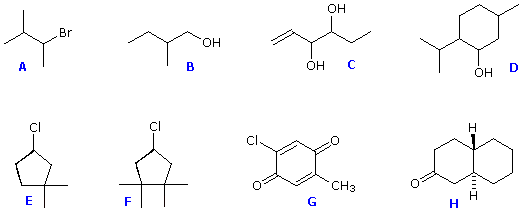
Structures F and G are achiral. The former has a plane of symmetry passing through the chlorine atom and bisecting the opposite carbon-carbon bond. The similar structure of compound E does not have such a symmetry plane, and the carbon bonded to the chlorine is a chiral center (the two ring segments connecting this carbon are not identical). Structure G is essentially flat. All the carbons except that of the methyl group are sp2 hybridized, and therefore trigonal-planar in configuration. Compounds C, D & H have more than one chiral center, and are also chiral. Remember, all chiral structures may exist as a pair of enantiomers. Other configurational stereoisomers are possible if more than one stereogenic center is present in a structure.
Polarimetry
Optical Activity
Identifying and distinguishing enantiomers is inherently difficult, since their physical and chemical properties are largely identical. Fortunately, a nearly two hundred year old discovery by the French physicist Jean-Baptiste Biot has made this task much easier. This discovery disclosed that the right- and left-handed enantiomers of a chiral compound perturb plane-polarized light in opposite ways. This perturbation is unique to chiral molecules, and has been termed optical activity.
Plane-polarized light is created by passing ordinary light through a polarizing device, which may be as simple as a lens taken from polarizing sun-glasses. Such devices transmit selectively only that component of a light beam having electrical and magnetic field vectors oscillating in a single plane. The plane of polarization can be determined by an instrument called a polarimeter, shown in the diagram below.
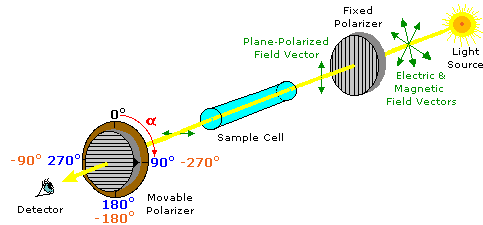
Monochromatic (single wavelength) light, is polarized by a fixed polarizer next to the light source. A sample cell holder is located in line with the light beam, followed by a movable polarizer (the analyzer) and an eyepiece through which the light intensity can be observed. In modern instruments an electronic light detector takes the place of the human eye. In the absence of a sample, the light intensity at the detector is at a maximum when the second (movable) polarizer is set parallel to the first polarizer (α = 0º). If the analyzer is turned 90º to the plane of initial polarization, all the light will be blocked from reaching the detector.
András Szilágyi has created a nice animation, illustrating various kinds of polarized light. This site may be examined by Clicking Here .
Chemists use polarimeters to investigate the influence of compounds (in
the sample cell) on plane polarized light. Samples composed only of achiral
molecules (e.g. water or hexane), have no effect on the polarized light
beam. However, if a single enantiomer is examined (all sample molecules
being right-handed, or all being left-handed), the plane of polarization is
rotated in either a clockwise (positive) or counter-clockwise (negative)
direction, and the analyzer must be turned an appropriate matching angle,
α, if full light intensity is to reach the detector. In the above
illustration, the sample has rotated the polarization plane clockwise by
+90º, and the analyzer has been turned this amount to permit maximum light
transmission.
The observed rotations (α) of enantiomers are opposite in direction. One
enantiomer will rotate polarized light in a clockwise direction, termed
dextrorotatory or (+), and its mirror-image partner in a
counter-clockwise manner, termed levorotatory or (–). The prefixes
dextro and levo come from the Latin dexter, meaning right, and
laevus, for left, and are abbreviated d and l
respectively. If equal quantities of each enantiomer are examined , using
the same sample cell, then the magnitude of the rotations will be the same,
with one being positive and the other negative. To be absolutely certain
whether an observed rotation is positive or negative it is often necessary
to make a second measurement using a different amount or concentration of
the sample. In the above illustration, for example, α might be –90º or
+270º rather than +90º. If the sample concentration is reduced by 10%, then
the positive rotation would change to +81º (or +243º) while the negative
rotation would change to –81º, and the correct α would be identified
unambiguously.
Since it is not always possible to obtain or use samples of exactly the
same size, the observed rotation is usually corrected to compensate for
variations in sample quantity and cell length. Thus it is common practice
to convert the observed rotation, α, to a specific rotation, [α], by
the following formula:
| Specific Rotation = | 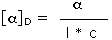 |
where l = cell length in dm, c = concentration in g/ml | |
| D is the 589 nm light from a sodium lamp |
Compounds that rotate the plane of polarized light are termed optically active. Each enantiomer of a stereoisomeric pair is optically active and has an equal but opposite-in-sign specific rotation. Specific rotations are useful in that they are experimentally determined constants that characterize and identify pure enantiomers. For example, the lactic acid and carvone enantiomers discussed earlier have the following specific rotations.
| Carvone from caraway: [α]D = +62.5º | this isomer may be referred to as (+)-carvone or d-carvone | |
| Carvone from spearmint: [α]D = –62.5º | this isomer may be referred to as (–)-carvone or l-carvone | |
| Lactic acid from muscle tissue: [α]D = +2.5º | this isomer may be referred to as (+)-lactic acid or d-lactic acid | |
| Lactic acid from sour milk: [α]D = –2.5º | this isomer may be referred to as (–)-lactic acid or l-lactic acid |
A 50:50 mixture of enantiomers has no observable optical activity. Such mixtures are called racemates or racemic modifications, and are designated (±). When chiral compounds are created from achiral compounds, the products are racemic unless a single enantiomer of a chiral co-reactant or catalyst is involved in the reaction. The addition of HBr to either cis- or trans-2-butene is an example of racemic product formation (the chiral center is colored red in the following equation).
| CH3CH=CHCH3 + HBr |  |
(±) CH3CH2CHBrCH3 |
Chiral organic compounds isolated from living organisms are usually optically active, indicating that one of the enantiomers predominates (often it is the only isomer present). This is a result of the action of chiral catalysts we call enzymes, and reflects the inherently chiral nature of life itself. Chiral synthetic compounds, on the other hand, are commonly racemates, unless they have been prepared from enantiomerically pure starting materials.
There are two ways in which the condition of a chiral substance may be
changed:
1. A racemate may be separated into its component enantiomers. This
process is called resolution.
2. A pure enantiomer may be transformed into its racemate. This
process is called racemization.