Acid-Base Catalysis
Acid-Base Catalysis
As we have noted, many common organic reactions proceed by bonding between nucleophilic and electrophilic sites in the reactant molecules. Three examples are shown in equations 1 through 3; electrophiles are colored red, and nucleophiles are colored blue.
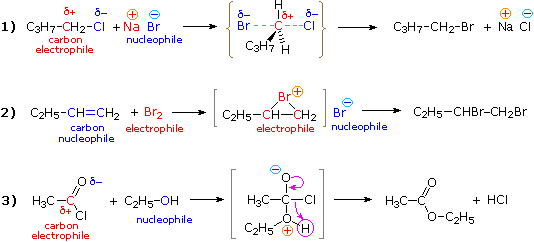
Reaction #1 is an example of an SN2 substitution reaction. The electrophilic carbon of 1-chlorobutane is attacked by the nucleophilic bromide anion in a single-step displacement process. The curly brackets enclose a structure for the transition state in this reaction.
Reactions #2 and #3 are two-step sequences. In the former addition reaction, bromine (an electrophile) attacks the nucleophilic double bond of 1-butene to give an electrophilic cyclic-bromonium intermediate (enclosed in square brackets) accompanied by a nucleophilic bromide ion. This ion-pair is very short-lived, another nucleophile-electrophile bonding reaction leads to the product (1,2-dibromobutane). In reaction #3 (a substitution reaction) the electrophilic carbonyl carbon atom bonds to the nucleophilic oxygen atom of ethyl alcohol to give an intermediate (in square brackets) that eliminates HCl, yielding the ester ethyl acetate. In all of these examples the reactivity of the electrophiles and nucleophiles is sufficient to allow reaction to proceed spontaneously at room temperature.
It is not difficult, however, to find very similar combinations of compounds that either fail to react at all, or do so extremely slowly. Equations 4 through 6 illustrate this behavior for analogs of the first three reactions.
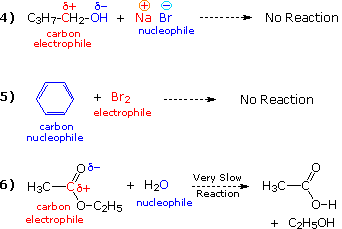
The factors that influence such differences in reactivity may be complex, but in the above cases are largely due to a poor anionic leaving group (eq. 4); aromatic stabilization and reduced nucleophilicity of a conjugated π-electron system (eq. 5); and reduced electrophilic character of a substituted carbonyl group (eq. 6).
First, compare reaction #4 with #1. Since oxygen is slightly more electronegative than chlorine
(3.5 vs. 2.8 on the Pauling scale), we might expect a C-O bond to be more polar than a C-Cl bond.
A better measure of the electrophilic character of a carbon atom in a compound comes from nmr
chemical shifts (both 1H & 13C), and these indicate that oxygen and
chlorine substituents exert similar effects when bonded to sp3 hybridized carbon atoms.
In any event, the failure of reaction #4 cannot be due to differences in the electrophilicity and
nucleophilicity of the reactants.
The key factor here is the stability of the leaving anion
(chloride vs. hydroxide). We know that HCl is a much stronger acid than water (by more than 15
powers of ten), and this difference will be reflected in reactions that generate their conjugate
bases. Thus, chloride anion is much more stable and less reactive than is hydroxide anion, so the
former is a better and more common leaving group. Indeed, the failure of alcohols to undergo
SN2 substitution reactions makes them useful solvents for many such reactions,
including #1.
In the case of reaction #5, the aromatic stabilization of the benzene ring makes it less susceptible to attack by electrophiles than are simple alkenes. Thus, elemental bromine is not sufficiently electrophilic to induce a reaction with benzene, even though the latter is nucleophilic.
Lastly, reactions #3 and #6 illustrate differences in the reactivity of carbonyl compounds. We
know that the carbon atom of a carbonyl group is electrophilic and undergoes reaction with a
variety of nucleophiles. However, this electrophilic character may be enhanced or diminished by
substituents. If we take saturated aldehydes (RCH=O) as a reference, the additional alkyl
substituent present in ketones slightly reduces this electrophilicity, but the general reactivity
pattern of these classes is similar. On the other hand, a chlorine substituent is inductively
electron withdrawing and increases the electrophilicity of the carbonyl carbon significantly.
Thus, acid chlorides are very reactive with a wide range of nucleophiles, including water and
alcohols (eq. 3).
The oxygen and nitrogen substituents present in esters and amides have a
similar inductive effect, but also a pronounced electron donating character through a resonance
interaction. Consequently, the carbonyl carbon atom becomes less electrophilic, and these
functional groups are less reactive than other carbonyl compounds. Thus, the failure of ethyl
acetate to react with water (eq. 6) reflects the reduced electrophilic character of its carbonyl
group.
Fortunately, these retarding factors can often be overcome by acid or base catalysis, which in general enhances electrophilicity (acids) or nucleophilicity (bases). Equations 7 through 9 show how this tactic may be effectively applied to the unreactive examples given above.
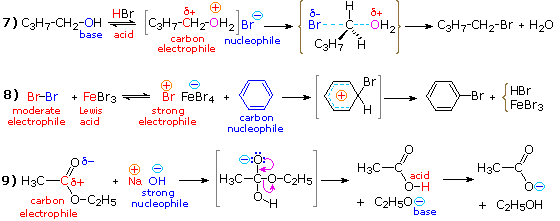
In strong acid, reaction #4 proceeds nicely, as shown in equation 7. This is because the leaving group has changed from hydroxide anion to water (the acidity of the conjugate acid H3O(+) is nearly that of HCl).
In the second example, there are two obvious ways of circumventing the failure of benzene to react with bromine:
- The bromine can be made more electrophilic
- The benzene ring can be made more nucleophilic.
The first tactic can be implemented by mixing bromine with ferric bromide, a Lewis acid catalyst. This generates the bromonium cation, Br(+), a powerful electrophile. Equation #8 illustrates this approach.
The second tactic requires that the benzene ring be activated (made more nucleophilic) by substitution with an electron donating group such as OH or NH2. For example, we find that phenol (hydroxybenzene) reacts rapidly with bromine in the absence of any catalyst.
Finally, we can see that there are two ways of facilitating the ester hydrolysis reaction.:
- We can use a stronger nucleophile than water, such as hydroxide anion.
- We can increase the electrophile reactivity by converting the ester to its conjugate acid, CH3C(OH)OC2H5(+).
Equation #9 shows the former approach, which is an example of base catalysis. Acid catalysis of the reaction also works well.