Lactone Formation
The reaction of carboxylic acids and alcohols to form esters is one of the best known transformations in organic chemistry. The preparation of ethyl acetate outlined in the following equation is a typical example. This reaction is modestly exothermic, and the standard enthalpy of reaction has been measured. Calculated values for the fundamental thermodynamic parameters are shown below the equation.
|
CH3CO2H + C2H5OH
|
ΔH° = –0.89 kcal/mole |
||
|
ΔH° = –0.80 kcal/mole |
ΔS° = +1.6 cal/ °K mole |
ΔG° = –1.28 kcal/mole kcal/mole |
(calculated) |
 CH3CO2C2H5 + H2O
This esterification reaction is very slow unless catalyzed by a strong acid. The calculated free energy change is –1.28 kcal/mole, which corresponds to a Keq = 8.7. In order to push the yield of ester beyond the 90% predicted for equilibrium, water is removed during the reaction.
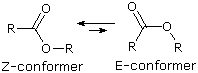 Compare the ethyl acetate esterification reaction with the lactonization of 4-hydroxybutanoic acid
shown below. The experimentally measured enthalpy of reaction is a mildly endothermic +1.08
kcal/mole, which is close to the value calculated from heats of formation. The nearly 2.0
kcal/mole increase in ΔH° reflects ring strain in the lactone, which is presumably a combination
of angle, eclipsing and other conformational strains. In general, esters prefer to adopt a
Z-conformation of the ester function, and this is not possible for six-membered and smaller rings.
Compare the ethyl acetate esterification reaction with the lactonization of 4-hydroxybutanoic acid
shown below. The experimentally measured enthalpy of reaction is a mildly endothermic +1.08
kcal/mole, which is close to the value calculated from heats of formation. The nearly 2.0
kcal/mole increase in ΔH° reflects ring strain in the lactone, which is presumably a combination
of angle, eclipsing and other conformational strains. In general, esters prefer to adopt a
Z-conformation of the ester function, and this is not possible for six-membered and smaller rings.

|
ΔH° = +1.08 kcal/mole |
||
|
ΔH° = +1.10 kcal/mole |
ΔS° = +13.9 cal/ °K mole |
ΔG° = –3.1 kcal/mole kcal/mole |
(calculated) |
Based on the endothermic shift in the lactonization reaction, one might expect it to be a slower and less complete process than intermolecular esterification. In fact, the opposite is true. Pure 4-hydroxybutyric acid is difficult to make and purify, and it tends to lactonize spontaneously and completely once formed. The intramolecular nature of lactonization explains the increase in rate, but does not account for lactone dominance at equilibrium. For this we must consider the free energy change in this lactonization:
ΔG° = +1.1 – (298 * 13.9/1000) = –3.1 kcal/mole
As shown, a large positive entropy factor opposes the unfavorable enthalpy component, yielding an exergonic ΔG°, which corresponds to a Keq =190. Thus, quantitative lactonization of the 4-hydroxybutyric acid should be expected.
A thermodynamic analysis of the lactonization of 5-hydroxypentanoic acid, n=3 in the formulas
written below, leads to similar conclusions. Although the strain in the six-membered lactone is
slightly higher than that of the five-membered lactone, the ΔG° for lactonization is still
exergonic, and all efforts to prepare the hydroxy acid itself have failed.
Analogous
lactonization of 3-hydroxypropanoic acid, n=1 in the following equations, forms a highly strained
four-membered ring, so it is not surprising that this cyclization does not proceed spontaneously.
A ΔH° of +23 to 25 kcal/mole testifies to the increased ring strain, and an estimated ΔS° of 40 to
43 cal/ °K mole does not reduce the enthalpy term by more than 5.5 kcal/mole. Consequently, the
ΔG° for lactonization is strongly endergonic at +17 to +19 kcal/mole, and this hydroxy acid will
most likely dimerize if forced to react.
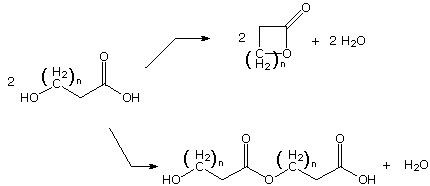
Terminal hydroxy acids having carbon chains longer than six (n > 3 above) may either lactonize or polymerize. With the exception of seven and eight-membered ring compounds, these lactones are not particularly strained, and are able to adopt Z-like ester conformations. The rate of lactonization is small due to the lower probability of conformations in which the hydroxyl and carboxyl groups are near each other in space (a negative entropy factor). If the concentration of hydroxy acid is high, dimerization and polymerization is favored. At low concentrations of hydroxy acid, lactonization becomes competitive.