The Mannich Reaction
The Mannich reaction is similar to a crossed aldol reaction in that a nucleophilic enol-donor forms a carbon-carbon bond to an electrophilic iminium-acceptor. This assembly is outlined at the top of the following diagram, using a methyl ketone as the enol precursor and an aldehyde iminium electrophile. Formaldehyde is a commonly used aldehyde reactant, as shown in the example below the mechanism. The Mannich base product is a β-aminoketone, usually formed as a mineral acid salt. These bases find use as stable precursors of reactive α,β-unsaturated carbonyl compounds, as illustrated in the same example. Eschenmoser's salt is a particularly useful source of formaldehyde for Mannich reactions.
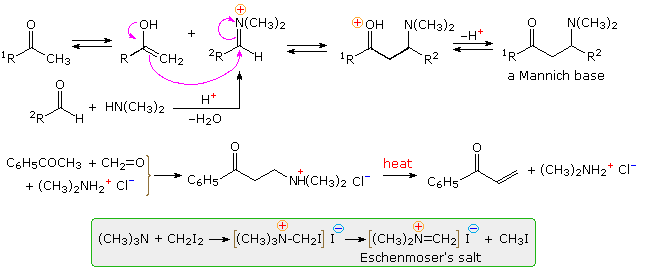
By clicking on the diagram, three additional examples of Mannich reactions will be displayed. The
first is a straightforward reaction involving the kinetically favored enol of a cyclic ketone. The
second shows the reaction of Eschenmoser's salt with a preformed lithium enolate. Such reactions
produce the free base directly. In order to effect the β-elimination of the amine, it is first
converted to a quaternary ammonium salt by methylation. Subsequent elimination is very rapid. The
last example is an unconventional case in which an intramolecular Mannich precursor is generated
in situ by an
azaCope rearrangement.
By
clicking on the diagram a second time, a remarkable synthesis of
the bicyclic aminoketone tropinone will appear above. This double Mannich sequence is known as the
Robinson-Schopf synthesis
in honor of the two chemists who first reported it in the first quarter of the 20th century. The
reaction takes place in water under physiological conditions (pH and temperature), and in high
yield.