Enols and Enolate Anions
Specific examples of enol tautomer and enolate anion concentrations for three different compounds are shown in the following table.
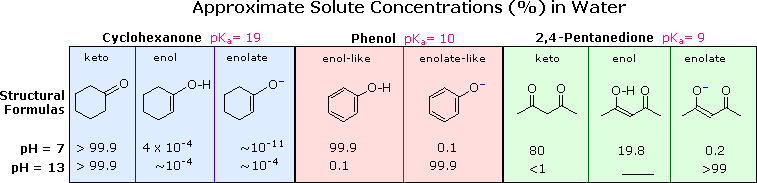
Cyclohexanone is a typical monoketone. Both the enol and enolate anion concentrations are very
small, even at pH=13. Phenol serves as a model for the enol tautomer of cyclohexanone, the
aromaticity of the benzene ring
stabilizing the hydroxyl form. The enhanced
acidity of phenols was explained
by charge delocalization in the conjugate base, a characteristic that is confirmed by
facile electrophilic substitution
of the aromatic ring. Although simple ketones have small equilibrium enol concentrations,
carboxylic acid derivatives such as esters and amides have even less enol, and are weaker
alpha-carbon acids.
The beta-dicarbonyl compound, 2,4-pentanedione, is remarkable in having a
much higher enol concentration than monocarbonyl aldehydes and ketones. Enol concentration is
solvent dependent, being greater than 90% in hexane solution. The acidity of the diketone is also
increased substantially, reflecting charge delocalization over both oxygens.
(–)O–C=C–C=O
 O=C–C=C–O(–)
The chemical behavior of beta-dicarbonyl compounds reflects their increased enol concentration and
acidity. Substitution reactions, such as halogenation and isotope exchange, occur more rapidly at
the central methylene group of 2,4-pentanedione than at the terminal methyl groups. Furthermore,
the corresponding enolate anion may be generated in hydroxylic solvents, using common bases like
sodium or potassium hydroxide.
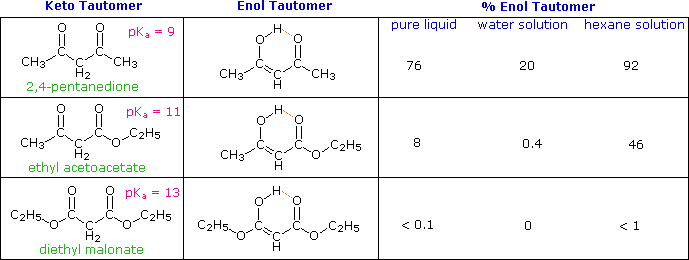
Two other beta-dicarbonyl compounds commonly used in organic
synthesis are ethyl acetoacetate, a beta-ketoester, and diethyl malonate, a diester. The weaker
influence of the ester carbonyl on enolization and acidity is evident from the data in the
following table. Even though diethyl malonate is the weakest acid of the three, it is easily
converted to its enolate base by treatment with sodium ethoxide in ethanol. Useful nucleophilic
intermediates of this kind are frequently employed in synthesis when suitable beta-dicarbonyl
reactants are available.