Nucleophilicity and Basicity Factors
Nucleophilicity and Basicity Factors in Organic Reactions
General Principals
Recall the definitions of electrophile and nucleophile:
Electrophile: An electron deficient atom, ion or
molecule that has an affinity for an electron pair, and will bond to a base or nucleophile.
Nucleophile: An atom, ion or molecule that has an
electron pair that may be donated in bonding to an electrophile (or Lewis acid).
Many functional groups have weakly electrophilic carbon atoms (colored red in the following examples). These include alkyl halides and sulfonate esters {C-X and C-OSO2R}, as well as carbonyl compounds such as aldehydes and ketones {C=O}. These electrophilic functions may react with nucleophiles (bases) in two distinct ways:
Because these electrophilic reactants are weak, such reactions normally require strong
nucleophiles or bases to proceed. However, if a preliminary ionization to a strongly electrophilic
carbocation occurs: [ C-X ——> C(+)
+ X(–) ]
or if the carbonyl group is converted to
its more electrophilic conjugate acid: [ C=O + A(+)——>(+)C-O-A]
then reactions with much weaker nucleophiles or bases may take place.
Some confusion in distinguishing basicity (base strength) and nucleophilicity (nucleophile
strength) is inevitable. Since basicity is a less troublesome concept; it is convenient to start
with it.
Basicity refers to the ability of a base to accept a proton. Basicity may be related
to the pKa of the corresponding conjugate acid, as shown below. The strongest bases
have the weakest conjugate acids and vice versa. The range of basicities included in the
following table is remarkable, covering over fifty powers of ten!
In an acid-base equilibrium
the weakest acid and the weakest base will predominate (they will necessarily be on the same side
of the equilibrium). Learning the pKa values for common compounds provides a useful
foundation on which to build an understanding of acid-base factors in reaction mechanisms.
| Base | I (–) | Cl (–) | H2O | CH3CO2(–) | RS(–) | CN(–) | RO(–) | NH2(–) | CH3(–) |
|---|---|---|---|---|---|---|---|---|---|
| Conj. Acid | HI | HCl | H3O(+) | CH3CO2H | RSH | HCN | ROH | NH3 | CH4 |
| pKa | -9 | -7 | -1.7 | 4.8 | 8 | 9.1 | 16 | 33 | 48 |

Nucleophilicity is a more complex property. It commonly refers to the rate of substitution reactions at the halogen-bearing carbon atom of a reference alkyl halide, such as CH3-Br. Thus the nucleophilicity of the Nu:(–) reactant in the following substitution reaction varies as shown in the chart below:

|
|---|
|
Nucleophilicity: CH3CO2(–) < Cl(–) < Br(–) < N3(–) < CH3O(–) < CN(–) < I(–) < CH3S(–) |

|
The reactivity range encompassed by these reagents is over 5,000 fold, thiolate being the most reactive. Clearly, there are significant differences between these nucleophilicities and the basicities discussed above.
Some useful trends have been documented:
(i) For a given element, negatively charged species are more nucleophilic (and basic)
than are equivalent neutral species.
(ii) For a given period of the periodic table, nucleophilicity (and basicity) decreases
on moving from left to right.
(iii) For a given group of the periodic table, nucleophilicity increases from top to
bottom (i.e. with increasing size),
although there is a solvent dependence due to
hydrogen bonding. Basicity varies in the opposite manner.
For two or more molecules incorporating nucleophilic atoms of the same kind and charge, the stronger base is usually the stronger nucleophile. Thus, 2,2,2-trifluroethoxide (pKa 12) is a weaker base and nucleophile than ethoxide (pKa 16). A notable exception to this rule occurs when a vicinal (adjacent) atom carries a non-bonding electron pair. Two common examples of this exception, called the alpha effect, are hydroxide ion (pKa 15.7) compared with hydroperoxide ion (pKa 11.6), and ammonia (pKa 9.3) compared with hydrazine (pKa 8.0). In each of these pairs the weaker base is the stronger nucleophile.
Solvent Effects
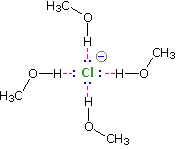 Solvation of nucleophilic anions markedly influences their reactivity. The
nucleophilicities cited above were obtained from reactions in methanol solution. Polar, protic
solvents such as water and alcohols solvate anions by hydrogen bonding interactions, as shown in
the diagram on the right. These solvated species are more stable and less reactive than the
unsolvated "naked" anions. Polar, aprotic solvents such as DMSO (dimethyl sulfoxide), DMF
(dimethylformamide) and acetonitrile do not solvate anions nearly as well as methanol, but provide
good solvation of the accompanying cations. Consequently, most of the nucleophiles discussed here
react more rapidly in solutions prepared from these solvents. These solvent effects are more
pronounced for small basic anions than for large weakly basic anions. Thus, for reaction in DMSO
solution we observe the following reactivity order:
Solvation of nucleophilic anions markedly influences their reactivity. The
nucleophilicities cited above were obtained from reactions in methanol solution. Polar, protic
solvents such as water and alcohols solvate anions by hydrogen bonding interactions, as shown in
the diagram on the right. These solvated species are more stable and less reactive than the
unsolvated "naked" anions. Polar, aprotic solvents such as DMSO (dimethyl sulfoxide), DMF
(dimethylformamide) and acetonitrile do not solvate anions nearly as well as methanol, but provide
good solvation of the accompanying cations. Consequently, most of the nucleophiles discussed here
react more rapidly in solutions prepared from these solvents. These solvent effects are more
pronounced for small basic anions than for large weakly basic anions. Thus, for reaction in DMSO
solution we observe the following reactivity order:
Nucleophilicity: I(–) < Br(–) < Cl(–) ~ N3(–) < CH3CO2(–) < CN(–) ~ CH3S(–) < CH3O(–)
Note that this order is roughly the order of increasing basicity (see above).