Retrosynthetic Analysis
The useful approach of working out syntheses starting from the target molecule and working backward toward simpler starting materials has been formalized by Prof. E. J. Corey (Harvard) and termed retrosynthetic analysis. In this procedure the target molecule is transformed progressively into simpler structures by disconnecting selected carbon-carbon bonds. These disconnections rest on transforms, which are the reverse of plausible synthetic constructions. Each simpler structure, so generated, becomes the starting point for further disconnections, leading to a branched set of interrelated intermediates. A retrosynthetic transform is depicted by the => symbol, as shown below for previous examples 2 & 3. Once a complete analysis has been conducted, the desired synthesis may be carried out by application of the reactions underlying the transforms.
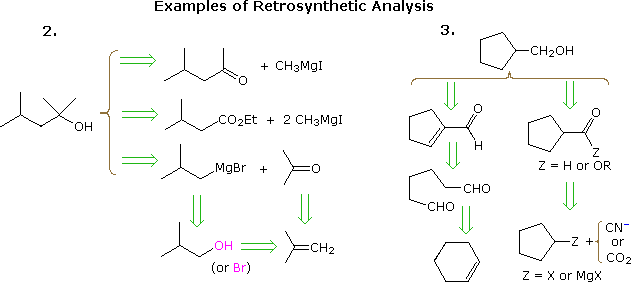
The above diagram does not provide a complete set of transforms for these target compounds. When a
starting material is specified, as in the above problems, the proposed pathways must reflect that
constraint. Thus the 4-methyl-2-pentanone and 3-methylbutyrate ester options in example 2, while
entirely reasonable, do not fit well with a tert-butanol start. Likewise, a cyclopentyl
intermediate might provide an excellent route to the product in example 3, but does not meet the
specified conditions of the problem.
Retrosynthetic analysis is especially useful when
considering relatively complex molecules without starting material constraints. If it is conducted
without bias, unusual and intriguing possibilities sometimes appear. Unfortunately, molecular
complexity (composed of size, functionality, heteroatom incorporation, cyclic connectivity and
stereoisomerism) generally leads to very large and extensively branched transform trees. Computer
assisted analysis has proven helpful, but in the end the instincts and experience of the chemist
play a critical role in arriving at a successful synthetic plan. Some relatively simple examples,
most having starting material restrictions, are provided below.
Retrosynthetic Example 1
A synthesis of N-ethyl-2-aminomethylspiro[3.3]heptane from starting compounds having no more than three contiguous carbon atoms is required. This provides a good example of the importance of symmetry in planning a synthesis. First, it should be recognized that the amine group is best introduced at the end of the synthesis, by reacting ethylamine with an ester (or acyl chloride derivative) of spiro[3.3]heptane-2-carboxylic acid, followed by LiAlH4 reduction. This approach avoids the necessity of protecting a nucleophilic nitrogen from undesired participation in other reactions. Second, the symmetry of the remaining carbon skeleton suggests its disconnection into 1,3-difunctionalized propane units, as shown below. All of these have a common origin in diethyl malonate, which can be reduced to a 1,3-glycol and then converted into 1,3-dibromopropane.
![Retrosynthesis of N-ethyl-2-aminomethylspiro[3.3]heptane: disconnect to 1,3-difunctional propane units from diethyl malonate](/reusch/virtualtext/img/retro5.gif)
Retrosynthetic Example 2
A synthesis of 2,7-dimethyl-4-octanone from starting compounds having no more than four contiguous
carbon atoms is required. The structural formula and a first-stage retroanalysis of this ketone
are displayed in the following diagram. Three straightforward disconnections are shown, as drawn
by the dashed lines. The first (magenta arrow) is undoubtedly the simplest, since a Grignard
reagent addition to a suitable nitrile gives the product directly. However, one or more of the
reactants is larger than C4 and must therefore be prepared independently before use. A
two-step procedure involving Grignard addition to an aldehyde, followed by oxidation of the
2°-alcohol product, also suffers the same requirement, as do the epoxide opening routes presented
in the second row (cyan arrow). Secondary preparations of these intermediates are easily conceived
by way of cyanide substitution of a 1°-halide, coupling of a Gilman reagent with allyl bromide, or
Grignard addition to ethylene oxide.
The last disconnection (green arrow) creates the desired
carbon skeleton by sequential alkylations of terminal alkynes (first acetylene and then
4-methyl-1-pentyne). Mercury catalyzed hydration of the symmetrical octyne product generates the
desired ketone. All the necessary reactants are C4 or less, so the synthesis is
accomplished in three steps (not counting the formation of alkyne salts).
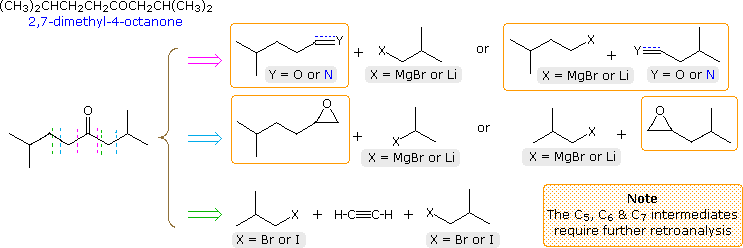
Three more first-stage analyses will be displayed above by clicking on the diagram. The first of
these (red arrow) is a two step sequence initiated by isobutyl magnesium bromide addition to
acetonitrile, followed by isobutyl bromide alkylation of the resulting 4-methyl-2-pentanone.
Regioselective control might be a problem in the last step. The second disconnection (orange
arrow) suggests an α, α'-dialkylation of acetone. Since acetone itself is prone to base-catalyzed
condensation, this might be difficult to accomplish directly. However, the use of ethyl
acetoacetate avoids this problem for the first step, and the second alkylation is the same one
proposed as part of the first disconnection synthesis. Both of these sequences would provide
efficient routes to the target ketone.
Finally, the last disconnection is a four component
assembly consisting of two conjugate additions and a Grignard addition. This would most likely
result in a longer and lower yield procedure than the previous two.
Retrosynthetic Example 3
A synthesis of 1,4,6--trimethylnaphthalene from para-xylene and other starting compounds
having no more than four contiguous carbon atoms is required. Plausible transforms for the
attachment of the second ring carbons to para-xylene are
Friedel-Craft alkylation or
acylation (acylation is usually better), nucleophilic attack of an
aryl metal reagent derived from
2-bromo-para-xylene on carbonyl or epoxide electrophiles, or possibly by cycloaddition to a
aryne intermediate. A
palladium catalyzed coupling reaction
might also prove useful. Because of their simplicity and broad scope, we shall consider only the
first two transforms.
The following diagram shows retrosynthetic analyses based on the
Friedel-Craft transform for both bond formations to the aromatic ring. Of these, the first seems
to offer the most efficient synthesis route, consisting of Friedel-Craft acylation, Wolff-Kischner
reduction, a second Friedel-Craft acylation and methylation of a ketone enolate. In all cases the
substituted tetralone precursor of the desired naphthalene must be reduced to an alcohol and
dehydrated. The resulting dihydro naphthalene is then aromatized by Pt catalyzed dehydrogenation,
or mild oxidation by heating with sulfur or selenium.
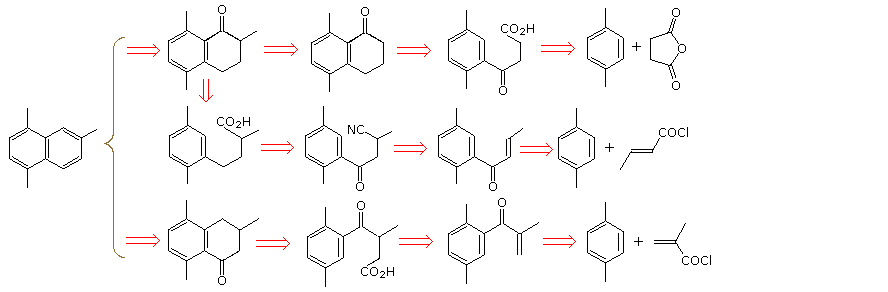
By clicking on the diagram, a new set of disconnections, starting from 2-bromo-para-xylene, will be displayed. A derived Gilman or lithium reagent is used for conjugate addition to an unsaturated carbonyl compound or ring opening of an epoxide. Further lengthening of the side chain is effected by cyanohydrin formation (top example), malonic ester alkylation (middle example), and Arndt-Eistert homologation (bottom example). The final steps must then parallel those used for the first examples.
Retrosynthetic Example 4
A synthesis of 2-acetyl-2-methylbicyclo[2.2.2]octane from cyclohexene and other starting compounds
having no more than four contiguous carbon atoms is required. The target molecule has two bridged
six-membered carbon rings, and cyclohexene is one of the starting materials. Whenever a
six-membered carbon ring must be formed, possible Diels-Alder transforms should always be
considered. For such a construction one needs a conjugated diene and a dienophile. Cyclohexene
might be considered a dienophile, but acting as such would lead to a fused ring product, not a
bridged ring structure. Also, commonly used electron-rich dienes are not expected to react well
with an unstrained, electron-rich alkene.
If the role of cyclohexene is changed to that of a
diene, these objections are overcome. This alteration is easily managed by addition of bromine to
cyclohexene, followed by a double elimination, yielding 1,3-cyclohexadiene.
![Retrosynthesis of 2-acetyl-2-methylbicyclo[2.2.2]octane via Diels-Alder of 1,3-cyclohexadiene with 2-methylacrylonitrile](/reusch/virtualtext/img/retro6.gif)
The possible use of cyclohexadiene in this synthesis is shown above. A Diels-Alder cycloaddition to a dienophilic double bond generates the desired bicyclooctane ring system, and the task is to identify a reasonable intermediate for this purpose. Among the many reactions that form ketones, the addition of a Grignard reagent to a nitrile is particularly efficient. If we choose this as the last step, the dienophile becomes 2-methylacrylonitrile, and the retrosynthetic path is complete. The isolated double bond produced by the cycloaddition is reduced by catalytic hydrogenation, so distinction between exo and endo-addition products is lost (the endo-adduct shown predominated).
Retrosynthetic Example 5
A synthesis of 2-benzyl-3,3-dimethylcyclohexanone from benzene derivatives having no more than
seven carbons and other starting compounds having no more than four contiguous carbon atoms is
required. Since conjugate addition of a methyl group to 2-benzyl-3-methyl-2-cyclohexen-1-one
should proceed in good yield, this unsaturated ketone provides a good alternative target, as
shown. Once again, the cyclohexane ring suggests a Diels-Alder transform. Three such
disconnections are depicted in the following diagram along with a possible aldol cyclization
(example 4). Diels-Alder approach 1 is the most promising, since it features an electron-rich
diene reacting with an electron deficient dienophile. Chloroacrylonitrile is a useful surrogate to
ketene as a dienophile (ketene normally reacts by [2+2} cycloaddition). Hydrolysis of the
α-chloronitrile unit in the adduct converts it to a carbonyl group. Unfortunately, the
regioselectivity of this cycloaddition is likely to be poor, with
5-benzyl-4-methyl-2-cyclohexen-1-one (orange box bottom left) being formed in significant or
possibly major amount. Also, the diene, (3E)-3-methyl-5-phenyl-1,3-pentadiene, needed for this
reaction may be difficult to obtain as the desired stereoisomer (the Z-isomer will be relatively
unreactive because of steric hindrance in the cisoid conformation).
Diels-Alder synthesis 2
does not have a regioselectivity problem, but the reaction of an electron-rich diene with an
electron-rich dienophile is often sluggish and incomplete. Also the initial adduct has a methyl
ether where a carbonyl function is needed. The third Diels-Alder proposal in the gray-shaded area
has even more problems. As in reaction 2, electronic factors make the cycloaddition poor, and the
regioselectivity will likely favor the wrong adduct (circled in orange). Even if the desired
3,3-dimethylcyclohexanone were obtained, benzylation at the desired α-position (green) will have
to compete with that at the less hindered α'-position (magenta).
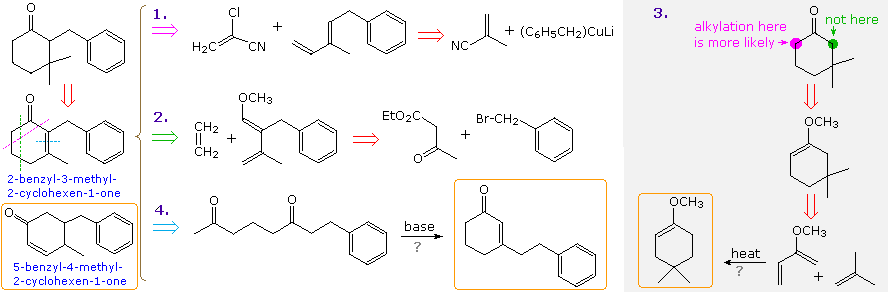
By clicking on the diagram, a new set of disconnections will be displayed. The first of these (top
line) is a cyclic aldol transform similar to the last case discussed. Here, however, the symmetry
of the 1,5-diketone (after decarboxylation) permits only one cyclohexenone product,
3-methyl-2-cyclohexen-1-one (drawn in the light gray box). This key synthetic intermediate, known
as a synthon, may lead to the target molecule in two ways, depending on the order in which
conjugate addition and α-alkylation are conducted. Another useful concept, revealed by the
disconnections in the last two rows, is that benzene derivatives may serve as precursors to
cyclohexane compounds.
By clicking on the diagram
a second time, the reactions which may be used to achieve the
proposed constructions will be shown above. Note the use of a
Birch reduction in the second line. All three
approaches should produce the target compound, the most efficient arguably being the third.
Retrosynthetic Example 6
A synthesis of all-cis-1,2,3,4-tetrakis(hydroxymethyl)cyclopentane from simple starting materials (six or fewer contiguous carbons) is required. Since carboxylic acids, esters, aldehydes and 1°-alcohols are easily interconverted, this target may be changed to the corresponding tetracarboxylic acid, as shown in the following diagram. Constructing the cyclopentane ring becomes a primary goal, and this may be done by condensation reactions (first two disconnections), cycloaddition (third disconnection) or by starting with a cyclopentane reagent (last example). Although there is precedent in known chemistry for all these approaches, some turn out to have serious flaws.
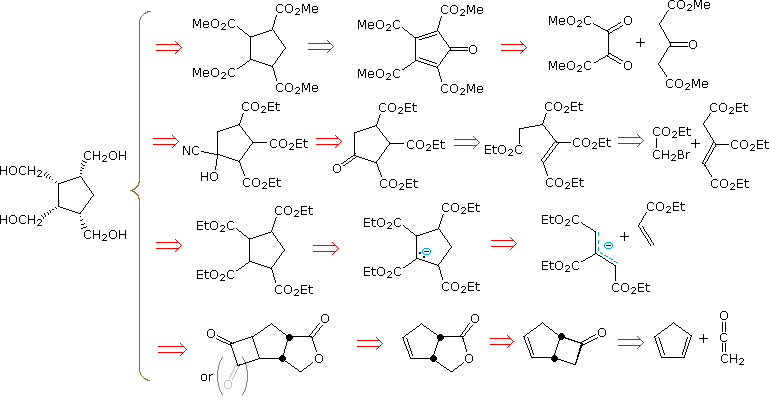
By clicking on the diagram, chemical reactions corresponding to each of the disconnection paths will be shown above. The first example, which takes advantage of symmetry, turns out to suffer from subsequent rapid Michael addition of a second acetonedicarboxylic acid moiety to the intermediate cyclopentadienone. This is, in fact, a general synthesis of bicyclo[3.3.0]octane-3,7-diones, known as the Weiss reaction. The second approach constructs the five-membered ring by a Dieckmann condensation of a tetra-carboxylic ester prepared from triethyl aconitate. Addition of the fourth carboxyl group by way of a cyanohydrin should be straightforward, but a mixture of stereoisomers will result, with the all-cis compound being a minor component. The cycloaddition proposed for the third approach is allowed by orbital symmetry, but only a few examples have been observed. Pursing this synthesis would be unwise, because it suffers from the same lack of stereoselectivity as the second case. Finally, The last approach, involving sequential [2+2] cycloaddition of ketenes to cyclopentadiene, is longer and has an inherent problem associated with the regioselectivity of the conventional Baeyer-Villiger oxidation. This problem may be overcome by using chiral catalysts (enzymes or transition metal complexes) with hydrogen peroxide, but a 50% conversion is the best that can be achieved and stereoselectivity may still be a problem.
A careful examination of the tetracarboxylic acid target reveals a possible precursor in which the cis carboxyl groups at C1 and C4 are masked by incorporation in a double bond. Such a bicyclo[2.2.1]heptene structure is readily achieved from 1,3-cyclopentadiene by way of a Diels-Alder reaction, as shown in the following retrosynthetic disconnection. With this as a guide, a simple three step synthesis may be proposed (shown by clicking on the diagram). The borohydride workup of the ozonolysis in the last step will convert aldehydes to 1°-alcohols.
![Retrosynthesis masking C1/C4 carboxyls in a bicyclo[2.2.1]heptene from cyclopentadiene plus maleic anhydride Diels-Alder](/reusch/virtualtext/img/retro12.gif)