The Leuckart Reaction
A useful procedure for the reductive alkylation of ammonia, 1°-, & 2°-amines, in which formic acid or a derivative thereof serves as the reducing agent, is known as the Leuckart Reaction. Some examples of this reaction are shown below.
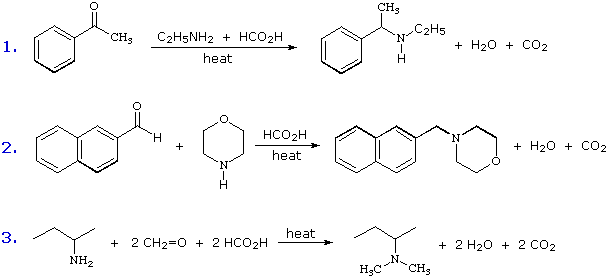
 The manner in which a hydride moiety is transferred from formate to an iminium intermediate is a
matter for speculation, but may be summarized roughly as shown on the right. Both aldehydes and
ketones may be used as the carbonyl reactant. By using ammonia as a reactant, this procedure may
be used to prepare 1°-amines; however, care must be taken to avoid further alkylation to 2° &
3°-amines. Polyalkylation is sometimes desired, as in example #3 where dimethylation is
accomplished with formaldehyde. This is sometimes referred to as the
Eschweiler-Clarke procedure, and it has proven to be a useful method for converting
1°-amines to precursors for
Hofmann or Cope elimination reactions.
The manner in which a hydride moiety is transferred from formate to an iminium intermediate is a
matter for speculation, but may be summarized roughly as shown on the right. Both aldehydes and
ketones may be used as the carbonyl reactant. By using ammonia as a reactant, this procedure may
be used to prepare 1°-amines; however, care must be taken to avoid further alkylation to 2° &
3°-amines. Polyalkylation is sometimes desired, as in example #3 where dimethylation is
accomplished with formaldehyde. This is sometimes referred to as the
Eschweiler-Clarke procedure, and it has proven to be a useful method for converting
1°-amines to precursors for
Hofmann or Cope elimination reactions.