The Haloform Reaction
Exhaustive base-catalyzed halogenation of methyl ketones is accompanied by C–C bond cleavage, yielding a carboxylate salt and haloform (X3CH). As shown in the diagram, an enolate conjugate base reacts with elemental halogen to form an α-halo ketone. This process is repeated until the α-site is fully halogenated. The trihalo derivatives formed from methyl ketones are then cleaved by base attack at the carbonyl group, reflecting the relative stability of the trihalomethyl anion as a leaving group.
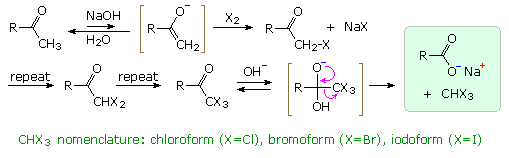
Before nmr became an essential tool for structure elucidation, a variant of the haloform reaction
called the iodoform test was used to identify methyl ketones, as well as alcohols that gave methyl
ketones when oxidized. By clicking on the diagram an illustration of this test will appear as
reaction 1. The iodoform product is an easily identifiable, bright yellow, water-insoluble solid
with a characteristic odor.
The haloform reaction has also been used to prepare carboxylic
acids, as in the synthesis of trimethylacetic acid from acetone shown in reaction 2. Dissolving
metal reduction of acetone gives the diol
pinacol, which then
undergoes acid-catalyzed
rearrangement to the methyl ketone
pinacolone.