Background
Introduction
The study of organic chemistry exposes a student to a wide range of interrelated reactions.
Alkenes, for example, may be converted to structurally similar alkanes, alcohols, alkyl halides,
epoxides, glycols and boranes; cleaved to smaller aldehydes, ketones and carboxylic acids; and
enlarged by carbocation and radical additions as well as cycloadditions. All of these products may
be transformed subsequently to a host of new compounds incorporating a wide variety of functional
groups, and thereby open to even further elaboration. Consequently, the logical conception of a
multistep synthesis for the construction of a designated compound from a specified starting
material becomes one of the most challenging problems that may be posed.
A one or two step
sequence of simple reactions is not that difficult to deduce. If, for example, one is asked to
prepare meso-3,4-hexanediol from 3-hexyne, most students realize it will be necessary to reduce
the alkyne to cis or trans-3-hexene before undertaking glycol formation. Permanaganate or osmium
tetroxide hydroxylation of cis-3-hexene would form the desired meso isomer. From trans-3-hexene it
would be necessary to first epoxidize the alkene with a peracid, followed by ring opening with
hydroxide ion. This example illustrates a common feature in synthesis:
often there is more than one effective procedure that leads to the desired product.
Longer multistep syntheses require careful analysis and thought, since many options need to be
considered. Like an expert chess player evaluating the long range pros and cons of potential
moves, the chemist must appraise the potential success of various possible reaction paths,
focussing on the scope and limitations constraining each of the individual reactions being
employed. This can be a daunting task, the skill for which is acquired by experience, and often
trial and error.
The three examples shown below are illustrative. The first is a simple
functional group conversion problem, that may initially seem difficult. It is often helpful to
work such problems backwards, starting from the product. In this case it should be apparent that
cyclohexanol may be substituted for cyclohexanone, since the latter could then be made by a simple
oxidation. Also, since cyclohexane (and alkanes in general) is relatively unreactive, bromination
(or chlorination) would seem to be an obvious first step. At this point one is tempted to convert
bromocyclohexane to cyclohexanol by an SN2 reaction with hydroxide ion. This reaction
would undoubtedly be accompanied by E2 elimination, so it would be cleaner, although one step
longer, to first make cyclohexene and then hydrate it by any of several methods (e.g.
oxymercuration and hydroboration) including the one shown by clicking on the diagram
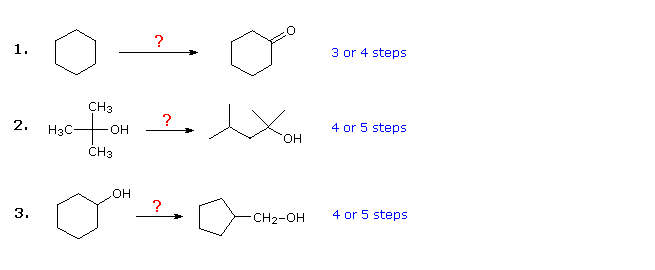
Plausible solutions for the second and third problem will also appear above at this point. In problem 2 the desired product has seven carbon atoms and the starting material has four. Clearly, two intermediates derived from the starting compound must be joined together, and one carbon must be lost, either before or after this bonding takes place. The 3°-alcohol function in the product suggests formation by a Grignard addition to a ketone, and isobutene appears to be a good precursor to each of these reactants, as shown. The reactant and product compounds in the third problem are isomers, but some kind of bond-breaking and bond-making sequence is clearly necessary for this structural change to occur. One possible procedure is shown above. Acid-catalyzed rearrangement of cyclohexene oxide, followed by reduction might also serve.
Historical Background
One of the earliest, and perhaps most significant-although accidental-examples of synthesis was reported by Friederich Wöhler in 1828. In an experiment designed to prepare ammonium cyanate from silver cyanate, he heated the latter with ammonium chloride expecting the outcome shown below.
| AgOCN + NH4Cl | ——> | ? NH4OCN + AgCl |
The product Wöhler obtained did not correspond to the expected cyanate salt, but was identified as
urea, NH2CONH2, an organic compound isolated from urine fifty years earlier.
This result was revolutionary in two respects. First it provided another example of isomerism, in
that ammonium cyanate, ammonium fulminate (NH4O-N=C) and urea are all isomers, a novel
concept for the time. Second it cast doubt on the widely held doctrine of vitalism, which
maintained that all living organisms were endowed with a vital or life force that rendered them
and their component parts uniquely different from ordinary "inorganic" matter. Thus, strongly
heating organic substances such as carbohydrates and proteins yielded water, ammonia and
carbonaceous solids (all inorganic), with loss of the vial essence. Wöhler's experiment was
acclaimed as the first conversion of an inorganic substance into an organic compound.
Less
than twenty years later, the German chemist Adolf Kolbe provided an even more convincing synthesis
of organic from inorganic substances. The two equations written below outline his experiment.
First, carbon disulfide, obtained by reaction of carbon with sulfur, was converted to carbon
tetrachloride by heating with chlorine, and the simultaneous pyrolysis of CCl4 yielded
a mixture of products which included tetrachloroethene, presumably formed from dichlorocarbene
(:CCl2). Treatment of tetrachloroethene with aqueous chlorine (think HOCl) gave
trichloroacetic acid, which Kolbe reduced electrolytically to acetic acid. This ended the reign of
vitalism as a scientific theory.
| CS2 + Cl2 + heat | ——> | CCl4 + Cl2C=CCl2 + many other products |
| Cl2C=CCl2 + Cl2 & H2O | ——> | CCl3CO2H ——> CH3CO2H |
During the 1850's, the French chemist Pierre Berthelot synthesized scores of simple organic
compounds, ranging from ethanol to acetylene and benzene, setting the stage for more ambitious
attempts. Just as the alchemists sought to transmute base metals into gold, early organic chemists
were drawn to the isolation or preparation of rare dyes, exotic perfumes and unusual spices, often
worth more than their weight in gold. A notable example of this interest is William Perkin's
attempt to synthesize quinine.
Quinine, an important drug for the treatment of malaria, was
available only from the bark of the South American tree Cinchona officinolis, and in the
mid 1850's a decline in the native tree population had caused a large rise in the price of the
drug. Very little was known about the compound, other than its molecular formula
C20H24N2O2. Nevertheless, in the spring of 1856,
William H. Perkin, a student (age 18) at the Royal College of Chemistry in London, attempted its synthesis in his
home laboratory. Perkin reasoned that oxidation of a suitable 10-carbon amine, such as allyl
toluidene, C10H13N, might generate quinine, as shown in the following
equation.
| 2 C10H13N + 3 K2Cr2O7 | ——> | ? C20H24N2O2 + H2O |
This simple approach failed, and from our vantage point a century and a half later it is easy to
see why. Many thousands of isomers having the molecular formula of quinine are possible, but only
one unique configuration of these 48 atoms constitutes a molecule of
quinine. That the atoms of
allyltoluidine should, in the course of one reaction, selectively reorganize and combine in this
specific fashion is beyond all reasonable probability.
Perkin's experiment was a failure only
in the respect it did not yield quinine, and his subsequent study of aromatic amine oxidations
demonstrates the value of persistence. From an impure sample of aniline he obtained a purple dye
he called aniline purple (also called mauve), which became the cornerstone of the synthetic
dyestuff industry in Europe and made a fortune for its discoverer.
A total synthesis of
quinine was achieved in 1944 by
R. B. Woodward
and
W. E. Doering
(Harvard), and improved syntheses continue to be reported.