HomeReuschVirtual Textbook Alkyl HalidesUnimolecular Syn-Eliminations

Unimolecular Syn-Eliminations

E2 elimination reactions are commonly bimolecular and prefer an anti-coplanar transition state. This important class of functional transformations is complimented by a small group of thermal, unimolecular syn-eliminations, described in the following table. The syn or suprafacial character of these eliminations is enforced by the 5- or 6-membered cyclic transition states (A & B) by which they take place.
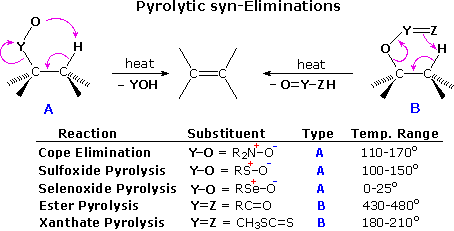
Pyrolytic syn-eliminations via 5-membered (A) and 6-membered (B) cyclic transition states, with a table of Cope, sulfoxide, selenoxide, ester, and xanthate types and temperatures

The temperature variations noted in the table suggest that these eliminations are facilitated by a negative charge on the O or Z atom and a low C–Y bond energy. Amine oxides have a full negative charge on the oxygen, and the Cope elimination proceeds well at temperatures near or slightly above 100 °C. Together with the Hofmann elimination, Cope eliminations have proven useful for removing a permethylated amino group from a larger molecule. Sulfoxides are eliminated to sulfenic acids at roughly similar temperatures as the amine oxides. Here, oxygen charge neutralization by p-d bonding to the positive sulfur atom is balanced by the weaker C–S bond. Selenoxides eliminate rapidly at low temperature, reflecting a greater charge on oxygen due to poorer p-d bonding (selenium is much larger than oxygen), and a weak C–Se bond.
Although a six-membered transition state is relatively unstrained, esters and thioesters of alcohols require higher temperatures for elimination. This is expected because of the stronger C–O bond and the lower polarity of C=Z. The thioester function of xanthate derivatives of alcohols undergoes elimination at much lower temperatures than carboxylic esters, probably reflecting a favorable bond energy change from O–C=S in the xanthate to S–C=O in the eliminated fragment.

Some examples of these syn-thermal eliminations are given in the following diagram. The ester pyrolysis in equation # 4 demonstrates the importance of a cis-alignment of the eliminating groups, in this case the acetate ester and the vicinal hydrogen atom. Xanthate ester pyrolysis (equation # 5) is known as the Chugaev (or Tschugaev) reaction. Finally, the conversion of 1°-alcohols to aryl selenium ethers prior to selenoxide elimination, as in example # 3, is carried out via a hypervalent phosphorus species similar to that involved in the Mitsunobu reaction. The preferred aryl group in the selenocyanate reagent is o-nitrophenyl.
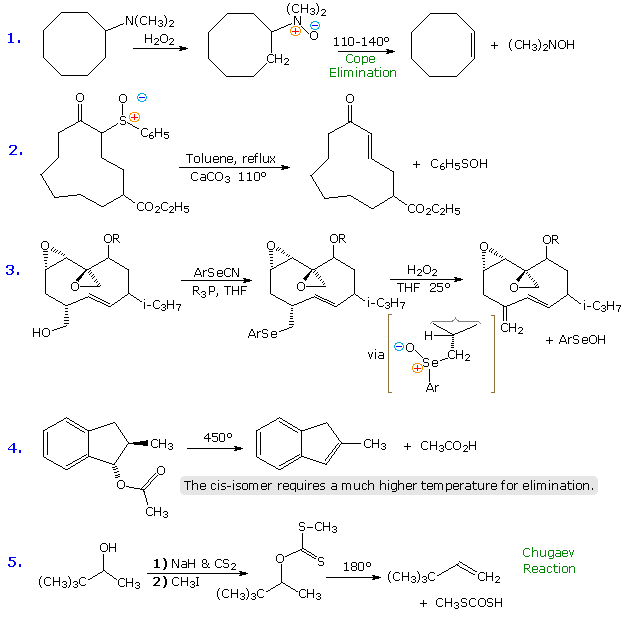
Five syn-elimination examples: Cope on a cyclooctyl amine oxide, sulfoxide, selenoxide via ArSeCN, cis-acetate ester pyrolysis, and a Chugaev xanthate elimination

Aldehyde Ketone Reaction Summary


Preparation
  • Commonly by oxidation of 1° & 2°-alcohols by chromium+6 reagents (e.g. PCC and Jones' reagent).
    Reactions
  • Aldehydes are oxidized to carboxylic acids by Jones' reagent or Tollens' reagent. Ketones are not.
    Both classes undergo the following chemical transformations:
  • Acetals and hemiacetals by reversible addition-elimination of alcohols. (acetals require removal of water)
  • Imines and enamines by reversible addition-elimination of 1° & 2°-amines respectively. (removal of water is necessary)
  • Cyanohydrins by reversible addition-elimination of HCN.
  • Reduction to1° & 2°-alcohols by NaBH4 and LiAlH4 (irreversible hydride addition).
  • Reduction to alkanes by Wolff-Kishner or Clemmensen conditions.
  • Formation of 1°, 2° or 3°-alcohols by addition of organometallic reagents to formaldehyde, other aldehydes or ketones.


    Carboxylic Acid Reaction Summary


    Preparation
  • By oxidation of 1° -alcohols, hydrolysis of nitriles, carboxylation of organometallic reagents and oxidation of arene side-chains.
    Reactions
  • Carboxylic acids are distinguished from other weak acids by reaction with sodium bicarbonate solution (gas evolution).
    Chemical transformations:
  • Salts are formed by reaction with a base.
  • Methyl esters are formed by reaction with diazomethane (CH2N2).
  • Acyl chlorides (acid chlorides) are formed by reaction with thionyl chloride (SOCl2).
  • Various esters are formed by reaction with alcohols and an acid catalyst (removal of water)
  • Reduction to 1°-alcohols by .
  • Formation of 1°-alcohols by LiAlH4 reduction.


    Reaction Summary for Carboxylic Acid Derivatives


    Preparation
  • By reactions of carboxylic acids; or by acyl transfer (see below).
    Reactions
    1. Acylation:
  • Acyl Chlorides
  • Water reacts to give a carboxylic acid and HCl.
  • Alcohols react to give esters and HCl.
  • Carboxylate salts react to give anhydrides.
  • Amines react to give amides and HCl (pyridine neutralizes the HCl).
  • Anhydrides
  • Water reacts to give the carboxylic acid.
  • Alcohols react to give esters and a carboxylic acid. (base removes the acid)
  • Amines react to give amides and a carboxylic acid. (base removes the acid)
  • Esters
  • Water reacts to give the carboxylic acid and the alcohol. (acid or base catalysis)
  • Alcohols react to give a new ester and an alcohol. (acid or base catalysis)
  • Amines react to give amides and an alcohol.
  • Amides and Nitriles
  • Water reacts to give the carboxylic acid and an amine or ammonia. (acid or base catalysis is necessary)
    2. Reduction:
  • Acyl Chlorides are reduced to aldehydes by reduction with LiAlH(t-BuO)3, or by H2 and a poisoned catalyst.
  • Esters are reduced to aldehydes by DIBAH at low temperature.
  • Esters are reduced to 1°-alcohols by LiAlH4
  • Amides and Nitriles are reduced to aldehydes by DIBAH at low temperature.
  • Amides and Nitriles are reduced to amines by LiAlH4
    3. Reaction with Organometallic Reagents:
  • Acyl Chlorides react with Gilman's reagent (R2CuLi) to give ketones.
  • Nitriles react with Grignard reagent to give ketones (after hydrolysis of the imine product).
  • Esters react with excess Grignard reagent to give 3°-alcohols. (2°-alcohols from formate esters)