Other Methods for Hydroxyl Substitution Reactions of Alcohols
The most common methods for
converting 1°- and 2°-alcohols to the corresponding chloro and bromo alkanes (i.e.
replacement of the hydroxyl group) is by treatment with thionyl chloride and phosphorus tribromide
respectively. These reagents are generally preferred over the use of concentrated HX due to the
harsh acidity of these hydrohalic acids and the
carbocation rearrangements associated
with their use.
Of course, it is possible to avoid such problems by first preparing a
mesylate or tosylate derivative, followed by nucleophilic substitution of the sulfonate ester by
the appropriate halide anion. In this two-step approach, a clean configurational inversion occurs
in the first SN2 reaction; however, the resulting alkyl halide may then undergo
repeated SN2 halogen exchange reactions, thus destroying any stereoisomeric identity
held by the initial carbinol carbon. For these and other reasons, alternative mild and selective
methods for transforming such alcohols by nucleophilic substitution of the hydroxyl group have
been devised. It should be noted that 3°-alcohols are not good substrates for the new procedures.
Drawbacks to the use of PBr3 and SOCl2
Despite their general usefulness, phosphorous tribromide and thionyl chloride have shortcomings. Hindered 1°- and 2°-alcohols react sluggishly with the former, and may form rearrangement products, as noted in the following equation.

By clicking on this equation, an abbreviated mechanism for the reaction will be displayed. The
initially formed trialkylphosphite ester may be isolated if the HBr byproduct is scavenged by
base. In the presence of HBr a series of acid-base and SN2 reactions take place, along
with the transient formation of carbocation intermediates. Rearrangement (pink arrows) of the
carbocations leads to isomeric products.
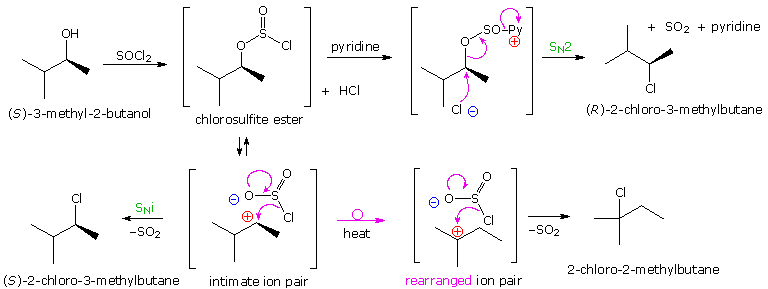
Reaction of thionyl chloride with chiral 2°-alcohols
has been observed to proceed with either inversion or retention. In the presence of a base such as
pyridine, the intermediate chlorosulfite ester reacts to form an "pyridinium" salt, which
undergoes a relatively clean SN2 reaction to the inverted chloride. In ether and
similar solvents the chlorosulfite reacts with retention of configuration, presumably by way of a
tight or intimate ion pair. This is classified as an SNi reaction (nucleophilic
substitution internal). The carbocation partner in the ion pair may also rearrange. These
reactions are illustrated by the following equations. An alternative explanation for the retention
of configuration, involving an initial solvent molecule displacement of the chlorosulfite group
(as SO2 and chloride anion), followed by chloride ion displacement of the solvent
moiety, has been suggested. In this case, two inversions lead to retention.
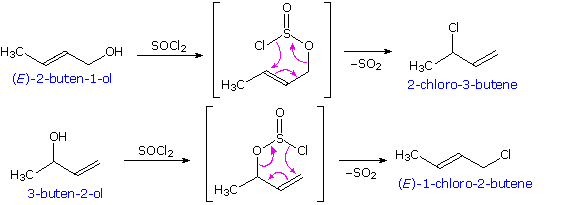
Another characteristic of thionyl chloride reactions is their tendency to give allylic rearrangement products with allylic alcohols. This fact is demonstrated by the following equations. Reactions of this kind have been classified as SNi', where the prime mark indicates an allylic character to the internal substitution. They may also be considered retro-ene reactions, a special class of pericyclic reactions. A similar substitutive rearrangement also occurs with propargyl alcohols, as shown by clicking on the equations.
Hypervalent Phosphorous Reagents
The ability of phosphorous to assume many different valencies or oxidation states was
noted elsewhere. The nucleophilicity of trialkyl phosphines allows them to
bond readily to electrophiles, and the resulting phosphonium ions may then bond reversibly to
other nucleophiles, especially oxygen nucleophiles. The use of phosphorous ylides in the
Wittig reaction is an example of this reactivity.
The reaction of
triphenylphosphine with halogens further illustrates this hypervalency. As shown in the following
diagram, triphenylphosphine (yellow box on the left) reacts to form a pentavalent dihalide, which
is in equilibrium with its ionic components in solution.

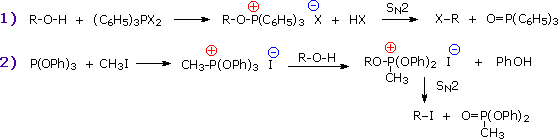
Chemists have made use of these and similar reagents to effect the mild conversion of alcohols to
alkyl halides with clean inversion of configuration. As with other OH substitution reactions, an
inherently poor leaving group (hydroxide anion) is modified to provide a better leaving group, the
stable compound triphenylphosphine oxide. Two such reactions are shown in the following diagram.
In this way even sluggish alcohols that are prone to rearrangement (e.g. neopentyl alcohol) are
converted to their corresponding halides.
The instability of vicinal diiodides relative to
their double bond analogs, is the driving force for a novel transformation of vic-glycols to their
corresponding alkenes. An example will be displayed by clicking on these equations. The allylic
rearrangement observed in thionyl chloride is similarly avoided by using triphenylphosphine
dichloride, or alternatively, by a two step procedure by way of a sulfonate ester. Click on the
diagram a second time for an example.
The Mitsunobu Reaction
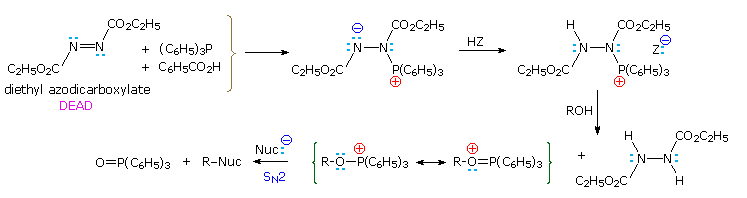
The Japanese chemist, O.Mitsunobu, devised a general and exceptionally versatile variant of hypervalent phosphorous chemistry that has been applied to wide selection of alcohols. This method, which now carries his name, uses a reagent mixture consisting of triphenylphosphine, diethyl azodicarboxylate (DEAD) and a moderate to strong acid. The steps leading to hydroxyl substitution are outlined in the following diagram. It should be noted that the nucleophile involved in the final SN2 substitution may be the conjugate base of the acid component or a separate species. A common use of the Mitsunobu reaction is to invert the configuration of a 2°-alcohol. This application usually employs benzoic acid or a benzoate salt, and the resulting configurationally inverted ester is then hydrolyzed to the epimeric alcohol. An example of this procedure will be displayed by clicking on the diagram.
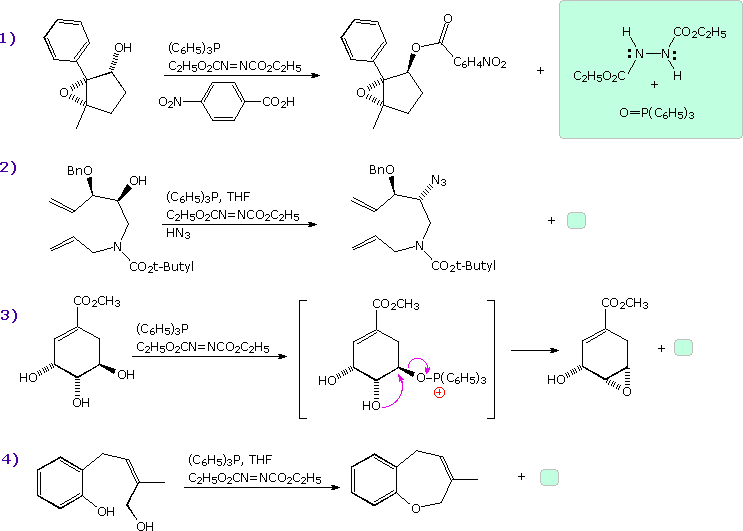
In addition to effecting configurational inversion of carbinol sites, the Mitsunobu reaction has also been used to introduce the azide precursor of amines and for the intramolecular preparation of cyclic ethers. Examples are shown below.